Sunday, 12 February 2017

Immigrant Ancestors -- Thomas Bliss (abt 1588-1651)

From Immigrant Ancestors
Continuing to look at my 9th grandfathers, we come to Thomas Bliss (abt 1588-1651), who arrived from England and settled first in Braintree, Massachusetts in 1635 with his wife, Margaret Hulins (1595-1684), whom he had married in Gloucester in 1621, and their family. They were fleeing religious persecution.

Founders' Monument, Hartford
By 1639, they were was in Hartford, where he is memorialized as another of my ancestors who were original founders there. I've noted in other blog posts that Hartford was settled by Puritans.

from Genealogy of the Bliss Family in America 
Thomas Bliss was a farmer, and came from a family of farmers in Devon. The always incredibly informative FamilySearch.org has a good overview of Thomas Bliss' origins and life here.

I've also found a book on archive.org, The Genealogy of the Bliss Family that was written in the 19th century by J. Homer Bliss. It is this source that states that my Bliss ancestors  came from Devon.

I can't wait to looking at this more thoroughly. It appears to have an excellent history the family in England, where my Bliss ancestors, Thomas Bliss (my 10th great grandfather) and his oldest son, Jonathan, ran afoul of Charles I in about 1628 and were imprisoned. The family's Devon lands, some of which had been in the family for over 200 years at that time, had to be sold to raise money to free them. But they could only raise enough money to free Thomas. Jonathan, it is said, received 35 lashes and was in poor health the rest of his life as a result. I should say so.

The Bliss Family History Society has an explanation of the origin of the Bliss name. Mark us down as Normans after reading that! There are many other resources about the Bliss family history that I have yet to explore, and sort out fact from not so fact.

I have to think that my ancestors in Hartford and elsewhere knew each other in these early days. After all, the population was small. My Bliss ancestors married into the Webster family

The never ending story continues.....


© Margaret Dougherty 2016-2017 All rights reserved

Saturday, 11 February 2017

Researchers find evidence of original 1620 Plymouth Settlement

News of the discovery of the original Plymouth Settlement was widely reported last November, but I came across it again today. A Cape Cod Times article reported on the find in November here. My own first settlers in Plymouth Colony in 1620 were Mayflower passengers Stephen Hopkins, his son Giles, from whom I descend directly, and the rest of their family. Stephen was the first of my immigrant ancestors profiled on this blog.

But I have many other ancestors who arrived after 1620 who were also original residents across in Plymouth Colony. A blog, The Vintage News, included this amazing map of Plymouth Colony in its story today. I like this map because it names the settlements within Plymouth Colony, and the years when each were settled. Many of these place names appear in my family tree. It's remarkable to see this map and to know of my connection to many of the place names in it. For me, this map is definitely a keeper!
from Vintage News Feb 2017

The never ending story continues....


© Margaret Dougherty 2016-2017 All rights reserved

Friday, 3 February 2017

The Eyemouth Fishing Disaster

Recently, a new DNA match contacted me. I absolutely love the DNA discoveries in genealogy. My new match and I are 5th cousins once removed, and both descend from William Young (1760-1846) and Alison Spears (1760-1841), who are my 4th great grandparents, and who raised their family in both Berwick upon Tweed and Eyemouth.

Eyemouth lies just over the Scotland/England border in the Scottish Borders, and today is a mere 13 kilometres up the A1 from Berwick upon Tweed. One website tells me that to walk between the two towns now would take just under three hours. I wonder what the travel time would have been in the horse and buggy era.

The two towns are so close that Berwick area newspapers have always included Eyemouth news. Families, including my many Young ancestors, went back and forth.

Eyemouth's main industry was herring fishing in the North Sea. On October 14, 1881, disaster struck when much of Eyemouth's fishing fleet was wiped out by a fierce storm. That morning, the sea was calm. Fishermen ignored warnings about the coming storm because they hadn't been able to fish during the week, and since they didn't fish on weekends, families would starve. There was no food. Many sources note that no Eyemouth family was left untouched by what came to be called the Eyemouth Disaster, or Black Friday.

It was from scanning headlines of the Berwick newspapers online that I first learned about the Eyemouth Disaster a few months ago. It would be commemorated annually, and was recalled when milestones in survivors' lives were reported up to the mid 20th century.

The Eyemouth Disaster took 129 men who lived in Eyemouth. They left behind at least 78 widows and 182 fatherless children (the numbers vary from source to source). An additional 70 victims came from surrounding villages, leaving behind even more widows and children. Eyemouth's population in 2011 was reported as 3,546. The 1881 census recorded 2,952 residents. What a huge impact the Eyemouth Disaster had on this small community.

This 2006 Scotsman article gives great background about the disaster and why it happened.

from Wikipedia
The disaster has been memorialized in several ways.

A granite monument to all who drowned was commissioned in 1912 and erected initially in the Eyemouth Cemetery after fundraising and other initiatives. The memorial's inscription reads:
Erected by public subscription to the memory of 189 east coast fishermen of which 129 belonged to Eyemouth, who perished at sea on 14th October 1881. 
A beautiful 15 ft long tapestry, recording the names of each of Eyemouth's 189 fishermen who died in the Disaster, was commissioned to commemorate the 100th anniversary of the disaster and hangs in Eyemouth Museum.

An oil painting depicting the aftermath of the disaster was featured on a 2013 Antiques Roadshow (UK) episode.

Black Friday is still remembered 136 years later. In October 2016, to mark the 135th anniversary, a magnificent new sculpture called Widows and Bairns was unveiled in Eyemouth's harbour names each mother and child directly affected, many of whom watched helplessly from shore as fathers, husbands, sons and brothers perished. The women and children are shown looking out to sea.  It remains today Britain's biggest fishing tragedy.

This link on the Eyemouth Museum's website tells more about the Disaster, and includes a short video segment made in October 2016 giving some moving oral history.

After the disaster, efforts were made to help the widows and families financially. Eventually, many family members had to move away from Eyemouth to find work.

Two of the victims that October day were part of my extended family: my 1st cousin 4x removed, William Young (1828-1881), and his son James (1857-1881), who was only 24 and left a wife, and six month old daughter. They were on two different boats that day. William was a nephew of my 3rd great grandfather, George Young (1799-1882).

My new DNA match? She is the direct descendant of William and James; the great granddaughter of that six month old child, and remembers her great grandmother talking about the disaster, which of course she didn't remember, but she certainly grew up hearing all about it, her father, grandfather and other extended family. What a wonderful gift to have those memories shared.

My new cousin has told me about a 2001 book that Children of the Sea: The Story of the People of Eyemouth by Peter Aitchison, a direct descendant of Eyemouth residents directly affected by the disaster. I look forward to reading this book.

The never ending story continues....


© Margaret Dougherty 2016-2017 All rights reserved

Sunday, 29 January 2017

Immigrant Ancestors -- Thomas Tupper (1578-1676)

The way back machine is still on: this week's immigrant ancestor is another 9th great grandfather, Thomas Tupper (1578-1676), who was born in Bury in Sussex, and died in the town he helped to found, Sandwich, on Cape Cod.

As a young man, Thomas was a ship's carpenter by trade. Sources report that he likely came first to New England in 1621, then again in 1624 and finally in 1631, when he remained. I descend from the 1634 marriage between Thomas and his third wife, Anne Hodgson (abt 1588-1676), who is described in multiple sources as a widow. Hodgson was her husband's last name. Her own maiden name is lost. Their only child -- both being in their 40s when they married -- was another Thomas Tupper (1638-1706), my 8th great grandfather.

In 1637, Sandwich, which had been part of Plymouth Colony, became the first town established on Cape Cod (scroll down to the heading, A Brief History of Sandwich). Thomas is listed in documents as one of ten men granted proprietorship of land that formed the settlement of  Sandwich.

The original Tuppers in England were reportedly of Saxon descent. By the 17th century, my Tuppers were Puritan in their earliest days in America. Some of Thomas' descendants later became deacons or ministers in their churches -- faith was very important to early North American settler families, especially the Tuppers, where you see the biblical names Eliakim and Elias used from generation to generation. This much older source tells a bit more of the Tupper family and Thomas' life in Sandwich.

North America, Family Histories
My own Tupper line migrated from Cape Cod to Nova Scotia, among the New England Planters. Descendants of the first Tupper in North America, are scattered across Canada today.

One notable descendant is my 3rd cousin 5x removed, Sir Charles Tupper (1821-1915), who was one of Canada's Fathers of Confederation, premier of Nova Scotia, and for ten weeks, Canada's prime minister.

The never ending story continues....


© Margaret Dougherty 2016-2017 All rights reserved

Friday, 27 January 2017

Our Canada - Your family: building a nation

I belong to the Ontario Genealogical Society, which has the distinction of holding Canada's largest annual genealogy conference.

I'm so pleased to be a member of this year's conference social media team.

The theme for this year's conference is explained in its title: Our Canada - your family: building a nation.

From time to time over the next five months, I'll post information about this year's conference, being held in our nation's capital, Ottawa, which is so fitting since this year marks Canada's sesquicentennial--that's 150 years in plain language.

Bear with me here as I post periodic blurbs about this year's conference. Check out the program here.

The never ending story continues....


© Margaret Dougherty 2016-2017 All rights reserved

Wednesday, 25 January 2017

The Weatherburns of Spittal, Tweedmouth and elsewhere

Some say Weatherburn, some say Wedderburn. My connection to the Weatherburn family is through my 2nd great grandmother, Margaret Weatherburn (1833-1879).

I've traced my Weatherburn line in Northumberland back to a Henry Weatherburn, who married Agnes Tindal in 1742. His origins aren't completely clear, according to research I've read. But I'll continue to research.

There is a book about the history of the Wedderburns/Weatherburns that covers the period of 1296 to 1896 -- 600 years! I'm still perusing it from time to time, but it's easy to get distracted. The Weatherburns all had large families. So far, I have only Margaret as an ancestor, which considering the numbers of Weatherburns, Youngs and Knoxes in my ancestry is somewhat remarkable, I think.

I have a Weatherburn DNA match with one person, with whom I share 4th great grandparents: (another) Henry Weatherburn (1777-1858 and Agnes Milvin or Melvin (abt 1776-1832).

My Wedderburns/Weatherburns lived in Spittal, Tweedmouth, Norham and several other small places in and very near Berwick upon Tweed. They were primarily working class -- fishers and related occupations, and then railway or industrial-type work in the 18th and 19th centuries.

Spittal (or Spital--the spelling seems to vary, but Spittal seems the most common) is a small village across the Tweed River from Berwick. Its name is interesting, and according to this source, it is a shortened form of the word "hospital". Or, for viewers of Coronation Street, 'ospikle. Read a more detailed history of Spittal here.

Tweedmouth is, as its name implies, at the mouth of the Tweed River and borders on Berwick and Spittal. Read more.

The never ending story continues....


© Margaret Dougherty 2016 All rights reserved

Sunday, 22 January 2017

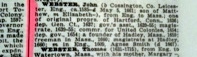
Immigrant Ancestors -- John Webster (1590-1661)

I've been easily led astray and distracted by more genealogy research again recently--so many bright shiny objects--but here we are back again.

John Webster (1590-1661) is yet another of my 9th great grandfathers. Born in
Leicestershire, England, John arrived at Massachusetts Colony in the early 1630s, most sources seem to generally agree, with his wife Agnes Smith (1585-abt 1655) and their surviving children.

John was of the first settlers of Hartford in 1636, and served one term as governor of  Connecticut Colony. He is mentioned among the names of Hartford's founders here and is name is included on a founders' monument.

from Find a Grave
In addition to my 8th great grandfather Thomas Webster (1616-abt 1686), John's many descendants include my 6th cousin 4x removed, Noah Webster (1758-1843), the lexicographer who compiled dictionaries, including his first, A Compendious Dictionary of the English Language. This evolved into Webster's Dictionary, which is still updated and published today. Wordsmithing is an old family trait it seems.

Another of John's descendants, my 5th great grandfather Abraham Webster (1737-1812), migrated from Connecticut to Nova Scotia with my 5th great grandmother Margaret White (1732-1803) as a New England Planter in about 1760, and received a land grant in Cornwallis. My New England roots in Nova Scotia are deep, thanks to my several Planter ancestors.

The never ending story continues....


© Margaret Dougherty 2016-2017 All rights reserved

About the Family of Robert Young and Isabella Knox

I wrote about my great grandfather, Robert Alexander Young , here . Now it's time to write about the family he and my great grandmother...