Showing posts with label Ross. Show all posts

Sunday, 18 August 2019

Alexander Ross married the girl next door: the 1841 census

I love connecting dots that lead to an exciting discovery, especially when it comes about in an aside made by another researcher who was writing to me about several overlapping genealogy matters.

It turns out that when the 1841 census of Scotland was conducted in Abernethy and Kincardine, my 2nd great grandparents-to-be lived next door to each other, each with their widowed mother. Stuff you can't make up. Really.

The census handwriting isn't 100 per cent clear, but is decipherable. Previously, I had relied on the 1841 census transcriptions available on FreeCen and Ancestry, not stopping to pay attention to the fact that the parish numbers (90A if you're interested) for both families are the same. I happily purchased the image from Scotland's People this morning.

1841 census of Ross household at Ryduack and Smith household at Straaneruie

First up are the Rosses of Ryduack: Alex, his mother Marjory and his sister Mary. Below that are the Smiths of Straanruie: Isabella and her mother Margaret, who share their cottage with four other people. Both households each have a farm servant, who were both Grants. Are the Grants connected to my Smiths and Rosses? Time will tell.

What's notable in the Straanruie household is that Margaret Smith's son-in-law, John Dow, was then visiting. John had married my 2nd great great aunt, Grace Smith in 1838.

Ryduack on ordinance map
Another researcher directed me to the National Library of Scotland's 1867-79 ordinance map of the area in which Ryduack and Straanruie are mentioned, and explained that these places were about five miles apart in the Abernethy Forest, which is in the mid-to-top of the right side of the map. To find these places, look for the river Duack from Ryduack to south of the Duack Dam. Straanruie is almost due south of that. These pull out shots may help you locate, if you're really interested. No?

Ryduack and Straanruie were both the property of the Earl of Seafield in 1841. I suspect the lands and those surrounding are still held by the current Earl of Seafield, the 13th of his name, in Game of Thrones parlance, who still today owns vast swaths of land in the Strathspey area. Both place names are old Scots Gaelic. The original spellings left transcriptions through the years open to the imagination, when the skills of census takers and ordinance map scribes did not include accuracy and spelling.

Straanruie on ordinance map

Tomgown (or Tomghobhain in Gaelic) in the district of Tulloch, birthplace of Isabella, can also be found on the larger map.

My 3rd great grandmother, Margaret Davidson Smith, was a widow by 1841. I don't know when Donald Smith died, but it is safe to say that it was before the census was done. Here's a post about their family.

Marjory McDonald Ross, my other 3rd great grandmother, was also a widow. Her husband, Duncan, died in 1824. I wrote about their family here.

So, Alexander married the girl next door, only next door in this case was about five miles apart. Did the families visit by boat or by foot through the forest?

The ordinance survey name books collected between 1868 and 1876 and now held by ScotlandsPlaces describe both Ryuack and Straanruie.

Ryduack description, ScotlandsPlaces OS1/16/1/68


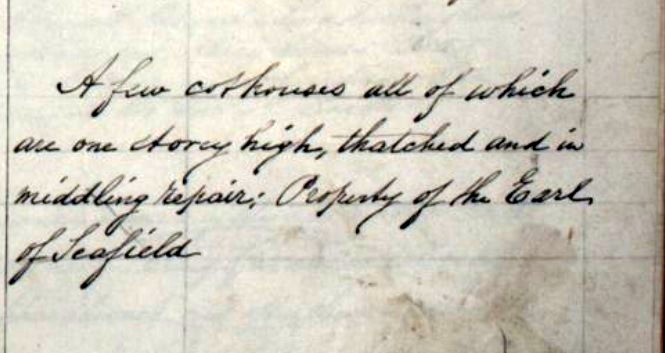
 Straanruie description, ScotlandsPlaces OS1/17/1/73

The third word in the description of Straanruie, cothouses, means a home for cottars, who usually had small pieces of land which they worked while also doing work for their land-holder, who was likely the local tenant farmer.

You're wondering when my 2nd great grandparents Alexander and Isabella got married, aren't you? So am I. So far, I haven't been able to find a marriage record. Their first child for whom there is a baptismal record was born in 1846.

Special thanks to three other family researchers who are wealths of information about all things Scotland, genealogy related.

The never ending story continues....


© Margaret Dougherty 2016-2019 All rights reserved


Wednesday, 6 June 2018

Ross: pushing back another generation...also, twins!

FamilySearch.org public domain
A few years ago, I found a baptismal record showing that my great grandmother Annie Ross (1849-1922) had given birth to a baby girl that she brought with her into her 1878 marriage to my great grandfather, Frank Gillanders Matheson. That daughter, Annie Munro Ross, sadly died at the age of 8 in 1882, possibly from peritonitis.

FamilySearch.org public domain
Later, I discovered that Annie had in fact borne twins when her daughter was born on 21 Feb 1874 after another baptismal record discovery led to her son, Henry Ross, who sadly died the same day he and his sister Annie were born. These were the only set of twins I'd ever found in all of my genealogy research. Until now.

Since finding the grave marker of Annie's grandparents (my 3rd great grandparents) Duncan Ross and Marjory McDonald online, I've been looking for their parents. And now, I'm fairly certain I've found Duncan's parents, while at the same time discovering that he was also a twin. Yes, it's one of those aha moments! Take a look:

FamilySearch.org public domain
That's right. Duncan's mother's maiden name was Munro. The Munro name and the fact that he was also a twin is just far too coincidental. I've learned not to ignore genealogical coincidences.  While Annie hadn't named the father in her twins' baptismal records, I had assumed that Munro was a clue to his last name. But no. My newest set of 4th grandparents are George Ross and Margaret Munro.
FamilySearch.org public domain


I have confirmed DNA matches with others pointing to Duncan and Marjory McDonald as common ancestors. I'm looking forward to finding new DNA matches with George and Margaret as common ancestors.

Oh, and in a further coincidence, my new-found 3rd great aunt Katherine Ross married a man named John Davidson, with whom she had at least eight children. I have a Scottish 3rd great grandmother, Margaret Davidson (1778-1863). I have to wonder if Katherine's husband is a close relation to this Margaret.

Aha moments in genealogy research really are the absolute best.

The never ending story continues.....


© Margaret Dougherty 2016-2018 All rights reserved

Wednesday, 28 February 2018

New Ross DNA cousin connections

Experiencing genealogy excitement is a feeling that only other genealogists can appreciate. I've recently had some of more of those feels, when I heard back from a woman I had messaged on Ancestry.

I had discovered a previously unknown 2nd great uncle, Thomas William Ross (b abt 1814 in Scotland), mentioned here, who had gone to St Vincent in the Caribbean in the 1800s. On Ancestry, I found two other trees that mention him. I contacted both tree owners, and heard back from one of them. My newest DNA cousin tells me that it is her family's belief that Thomas fathered a child while in St Vincent, and that he is her 3rd great grandfather. DNA testing that shows that in addition to African DNA, she also has British and Irish DNA.

Off I went to start research of St Vincent records, only to quickly screech to a halt. Genealogy research of St Vincent records is very challenging. Much hasn't been digitized, and there is also the reality that record keeping was less than complete there in the 19th century.

My newest DNA cousin thinks that Thomas returned to Scotland in the 1860s, but I can't find any trace of him in Scotland's People, or looking in the UK's BMD census records. So far. It may take time, but I'm very hopeful that I'll eventually find out whatever happened to great great uncle Thomas.

Meanwhile, I'm looking forward to finding out more about his likely descendants, that sprang from the child he is believed to have fathered in St Vincent. While I'll work on establishing some contact with the St Vincent Archives, I hope to get more information from my latest DNA cousin and will try not to ask too many questions all at once in my excitement.

If you're a descendant of my ancestor great uncle, please contact me, using the email link to the right on this page.

The never ending story continues....


© Margaret Dougherty 2016-2018 All rights reserved

Sunday, 28 January 2018

Meet the family of Duncan Ross & Marjory McDonald

Yesterday's discovery of the burial location of my latest 3rd great grandparents Duncan Ross (1776-1824 and Marjory McDonald (1781-1844) came quite indirectly, and through the discovery of a previously unknown son to them, who is a 2nd great uncle to me.

While doing some Google research, I came across mention of them in a 1998 book called Scots in the West Indies, where they are listed as the parents of one Thomas William Ross b 1814, who settled in St Vincent.

The place name Rydnach mentioned below is one of at least five spelling variations for the place name Ryduack, which was a long ago township where Nethy Bridge is today in Inverness-shire. I'm going with Ryduack on a go forward basis, as that is how it appears on at least two Scottish government websites, and have updated all my records to reflect that spelling, hoping it too will open some new doors in my research.

from Scots in the West Indies
Like the marriage of Duncan and Marjory and the baptism of my 2nd great grandfather Alex, there is no Old Parish Record of Thomas' baptism, but nonetheless, he's one of the family. After all, his name is recorded on his parents' grave marker. Thomas was the eldest child who lived to adulthood. His siblings were:
  • Alex (abt 1816-abt 1855)
  • Donald (1818-aft 1855)
  • Mary (1820-1856)
  • Annie (1822-1885)
Marjory, Alex and Mary all appear in the 1841 Scotland census living at Ryduack. Neither Mary nor Annie married and worked as general servants or farm labourers according to census records. I've not found Mary or Annie in the 1851 census, but Mary was at Ryduack when she died from fever on 29 May 1856. Her statutory death registry says her death was reported by "Alex Cameron, relative". I've not come across any Cameron ancestor cousins so far. This is another new name to add to my research. 

When the 1881 census was done, Annie was living with her sister in law, my 2nd great grandmother Isabella, (Alex' widow), at Seafield Place in Nethy Bridge, and died there from chronic bronchitis on 20 Sep 1885. Her death was reported by Isabella. 

I wrote about the children of Alex Ross, who include my great grandmother Annie Ross (1849-1922) in 2016 here.

As noted on the National Archives of Scotland website, Old Parish Records are far from complete. Locating Donald will be a challenge. I'm not sure when Thomas settled in St Vincent, or how long he stayed there, but have added "look for genealogy sources in St Vincent and the Grenadines" to my "to-do" list. More new mysteries to be solved. Hopefully, if they left any, one of their descendants will have had their DNA tested, and I'll find them that way.  

The never ending story continues....


© Margaret Dougherty 2016-2018 All rights reserved

Saturday, 27 January 2018

Found: The graves of Duncan Ross and Marjory McDonald


Duncan Ross and Marjory McDonald are another of my maternal third great grandparents. Randomly searching on Google (yet again, a genealogist's best friend), I've found a record of their deaths on Billion Graves, with the incredible added bonus of a photograph of their grave marker. The inscription reads:
Erected in memory of Duncan Ross late farmer of Ryduack who died there the 24th Sept 1824 aged 48 years and Marjory McDonald his spouse who died 7th Feb 1844 aged 63 years. 
This stone was placed by their two sons Donald Ross and Thomas William Ross.
Now, the last line above leads me to believe that this marker was erected after the death of their brother, my 2nd great grandfather, Alex Ross, who died about 1855, whose exact death date remains unknown.

There are two more lines below the last line above, but I can fully decipher these,

The grave is in the ancient kirkyard of Kincardine Church, which still stands today, in Abernethy and Kincardine, which today is in the county of  Inverness, Scotland, but until about 1870 in the county of Moray.

The dates and ages provided on the marker give me information to further narrow my search for their births, which hopefully will lead to confirmation of their parents.

The never ending story continues....


© Margaret Dougherty 2016-2018 All rights reserved

Wednesday, 2 November 2016

More adventures in DNA discoveries

Recently, the results of my sister's AncestryDNA test arrived. I'm continually fascinated by what can be learned from genealogical DNA tests, but am by no means a genetic genealogist.

I was curious to see what would emerge from a full sibling's DNA test, and I wasn't disappointed. Sure enough, matches to my sister's DNA are being identified that are absent from my own DNA results.

I'm the administrator of my sister's and brother-in-law's DNA tests, which, like mine, were also autosomal tests. While my sister and I have generally the same origins, the percentages of our origins aren't identical. Unlike me, her DNA shows 66% Ireland, 13% Europe West, 11% Scandinavia and 5% Great Britain, with traces of other regions. I'm more Viking, but less Irish, but we share the identical amount of Europe West DNA. Europe West, by the way, encompasses France, Germany, Belgium and Holland.

The day after we got her DNA results, one of her matches contacted me. This is a match that I don't have on my own DNA results. But my sister and I share the same 4th great grandparents, James Knox (abt 1729-1760) and Elizabeth Clark (abt 1729-) in Northumberland, England with this new contact. Exciting stuff! We've share our respective information with each other, and are adding to our own trees.

After all that excitement, this week, I uploaded sister's and brother in law's raw DNA data to GEDMatch, and while I was doing that, looked again at my own GEDMatch matches. The top match there had contacted me last year -- we are 4th cousins once removed and share the same Nova Scotia 3rd great grandparents, Elias Nelson (1783-1871) and Elizabeth Forbes (abt 1783-aft 1871).

But the second top match, with whom I share more 41.1% centimorgans of DNA was a mystery. So I emailed that contact, who turns out to be the match's son, and a pretty knowledgeable (and modest) guy when it comes to genetic genealogy.

By doing some mysterious calculations (I confess that anything to do with numbers gives me a twitch) and comparing our respective trees, my newest cousin quickly narrowed down that our common ancestor is likely an as yet unknown ancestor of my Scots maternal great grandparents Frank Matheson (1833-1909) or Annie Ross (1849-1922). He also triangulated (more twitches here) our DNA numbers with a third person's, who -- good grief-- has a PhD in biology and teaches genetic genealogy. She took the calculations one step further, leaving my head spinning even now. I'm still pondering the several reports these two new contacts sent me and now have two new surnames to research in Scotland: Grant and Cumming, based on the triangulation exercise.

The never ending story continues....

Thursday, 11 August 2016

Frank Matheson's wives and children 2

Frank & Annie marriage 6 Aug 1878
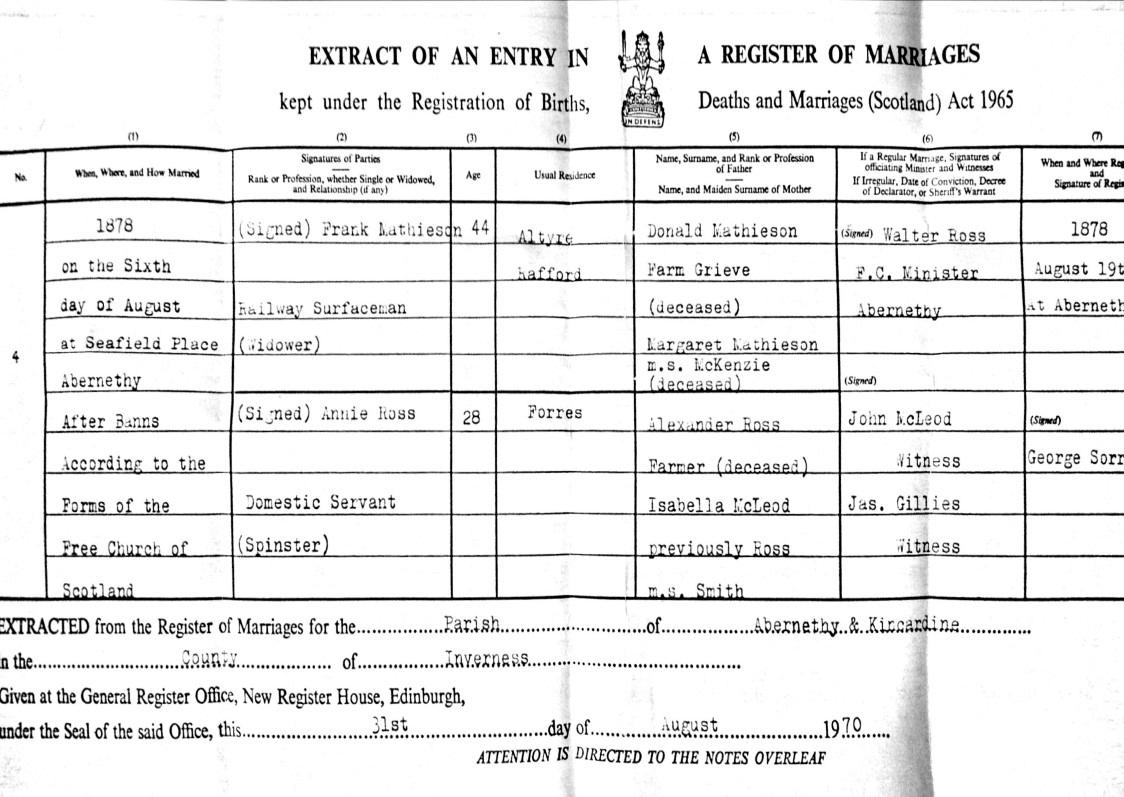
On 6 Aug 1878, Frank married a second time, to my great grandmother, Annie Ross (1849-1922). By this time, Frank is a railway surface man, and Annie is a domestic servant.

The marriage extract for Frank and Annie is filled with family history clues, I realized years after I had first seen it. The witnesses were Annie's half brother John McLeod (1856-1880) and her brother-in-law, James Gillies, who was married to Margaret Grace Darling Ross. Annie's mother Isabella is recorded on the extract with all of her names: Isabella McLeod previously Ross m.s. McLeod. I wonder if the Free Church of Scotland minister given, Walter Ross, was a relation to Annie. Another clue?

In marrying Annie, Frank also took on her four year old daughter, Annie Munro Ross (1874-1882), born out of wedlock. In fact, Annie gave birth to twins on 21 Feb 1874. Her son Henry died the same day he was born. We don't know who their father was -- Henry Munro perhaps? Was the father another domestic servant? I've never found any records giving any clues. Annie's little daughter Annie was only eight years old when she died. A family note says that the cause was possibly peritonitis.

Frank & Annie and family
Annie and Frank had eight children, three of whom died at one year old or less. Here is their family's page from Frank's bible.

My grandfather, John was their fourth child, but he was given the same name as their firstborn, also a John. My great uncle Frank was named after their son Francis who was born and died two years previous to young Frank's birth. Their daughter Isabella was named after Frank's late first wife. And their youngest daughter Annie could have been named for Frank's sister, her mother, or Annie's first daughter Annie. So many similar names in one family:
  • John (1879-1879)
  • Alexander (1880-1946)
  • Isabella McKenzie (1882-aft 1901)
  • John (1884-1964)
  • Marjory Law (1886-1887)
  • Annie (1888-1918)
  • Francis (1890-1890)
  • Frank (1892-1949)
Of Frank and Annie's five surviving children, only my great grandfather John, great uncle Frank and great aunt Annie had children. In the case of my grandfather and great uncle, they had only daughters, and so Frank's line of male Mathesons died out when my grandfather died in 1964.

The never ending story continues...

Frank Matheson's wives and children 1

My maternal great grandfather Frank Matheson married twice. His first wife was Isabella McKenzie (1840-1871). They married on 20 Apr 1866 in Inverness. As you can see from their marriage extract, he was a railway plate layer and she a domestic servant. The industrial age had reached the Highlands. This record also tells me that Frank's parents Donald and Margaret were deceased by the time Frank married.

Frank & Isabella marriage 20 Apr 1866
Frank and Isabella had three daughters, but sadly, Isabella died four days after the birth of her namesake, who herself died six weeks later.
  • Margaret Finlayson (1868-1887
  • Catherine (1869-1950)
  • Isabella (1871-1871)

The cause of Isabella's death was rheumatic fever.

Here is the page from Frank's bible recording his and Isabella's marriage and their children, as written by Frank.

Frank & Isabella and family
For 12 years, Frank was a single parent. The 1871 census for his household in Rafford, Morayshire, includes the name Catherine Matheson, who is identified as his sister-in-law and whose occupation is given as 'mother's wife' and her nine month old daughter, Margaret Matheson. Is 'mother's wife' a Highland term? Clearly, Margaret was helping to raise Frank's girls.

Only one of Frank's and Isabella's daughters lived to adulthood. Catherine (or Kitty as she was known), married Finlay Graham, a Glasgow police officer, the family story goes, on 2 Dec 1904. They had no children.

The never ending story continues...

Thursday, 4 August 2016

Grace Darling, 19th century national heroine

In this post I noted that one of my maternal great grandmother's sisters' name was Margaret Grace Darling Ross. I've always assumed that these were family names passed down through either the Ross or Smith families. I even used them trying to research further back.

Then I heard from an English friend this week who was reading my blog. She presumed I knew that Grace Darling was an English national heroine. Er, no, and kicked myself yet again to never make assumptions in family history. (Borrowing a line from Game of Thrones, you know nothing Margaret Dougherty.)

Off I went to research Grace Darling (1815-1842), aided by my friend's inclusion in her message of this link detailing Grace's story. In 1838, Grace and her lighthousekeeper father, William, were responsible for the rescue of nine passengers who survived when the paddlesteamer Forfarshire hit rocks at the Farne Islands off the coast of Northumberland in a gale enroute from Hull, England, to Dundee, Scotland and sank.

Grace Darling
Grace quickly rose to fame as word of her exploit spread far and wide. People wanted to fete her constantly, and it grew too much for her. She died, probably from tuberculosis, four years after this event.

Were many young girls in Scotland named to honour Grace? Or was there still some remote family connection to the Forfarshire? Did my 2nd great grandparents Alexander Ross and Isabella Smith honour the memory of Grace because a family member had been among the Forfarshire's crew or passengers? Had a family member helped to build the Forfarshire in Dundee in 1834?

What I do know is that my great great aunt, Margaret Grace Darling Ross, included the name Darling in at least one of her own daughters' names, Jessie Darling Mary Gillies (1880-1931).

The things you learn.

The never ending story continues...

Thursday, 21 July 2016

Brick Wall: Alexander Ross

According to the 1851 Scotland census my maternal great grandfather, Alexander Ross was born Abernethy, Elgin in Scotland. The problem in narrowing this down is that there are eight different Alexander Rosses recorded as being born in Moray between 1812 and 1817, all to different parents, of course. It's a big brick that I've yet to smash.

Not that I haven't tried. By the mid-1840s (another record that remains missing), he and Isabella Smith were married. They had at least four daughters:
  1. Marjory b 26 Jun 1846, Abernethy & Kincardine d aft 1874
  2. Margaret Grace Darling b 15 Dec 1847, Nethy Bridge, Abernethy  & Kincardine d 20 Jan 1932, Nethy Bridge, Abernethy & Kincardine
  3. Annie b 28 Nov 1849, Forres, Morayshire, d 24 Dec 1922, Nethy Bridge, Abernethy & Kincardine (my great grandmother)
  4. Alexandrina b 13 Apr 1856, Edderton, Ross and Cromarty, d 7 Jul 1872, Nethy Bridge, Abernethy & Kincardine
Alexandrina was a popular name at that time, as Queen Victoria's given names were Alexandrina Victoria. It was only after her 1837 accession to the British throne that she announced that she would be known as Victoria. The above Alexandrina, my great great aunt, was named after her father, but perhaps also Victoria. She was clearly born posthumously though, as Isabella married for a second time on 10 Jan 1856 to Angus McLeod in Cromdale, Inverallan and Advie in Inverness-shire.

I've never been able to locate a death record for Alexander. That's right. I can't find his birth or death records.

Alexander was a farmer, living at the address of Ryduack in Abernethy and Kincardine, Inverness-shire when the 1851 census was done, listing him, Isabella and their three eldest daughters.

Naming traditions in Scotland and Ireland typically, but not always, followed a pattern. The names of Alexander's daughters (isn't Margaret Grace Darling a grand moniker!) offer no clues in narrowing down his own parents from the eight possible Alexander Rosses. 

Scottish records are very difficult to find. One reason is that parish names changed through the years. As just one example, read about the former civil parish of Abernethy and Kincardine, which is mentioned above, and is where several of my ancestors lived, here. 

The never ending story (and hunt!) continues....

Saturday, 16 July 2016

On my Scots side .....

Continuing to introduce the cast of characters from my ancestry, my grandfather John Matheson was born to Frank Matheson and Annie Ross in 1884 at Clash Dhu, Rafford, Elgin, Morayshire, Scotland. This was Frank's second marriage. He lost his first wife, Isabella McKenzie, in 1871 following the birth of their third daughter. Frank maintained the family's births, marriages and deaths in his three volume (!) Church of Scotland bible, which was one of my initial sources for my Scotland ancestors.

My Scots ancestors were Highlanders.

Annie (1849-1922) was the third daughter of Alexander Ross (abt 1817- abt 1855) and Isabella Smith (1817-1915) and was born at Forres in Morayshire. Growing up, my mother told us, usually every time we passed Strathcona Avenue in Westmount (a town within Montreal), that we were related to Donald Smith, Lord Strathcona and Mount Royal. But honestly, with a name like Smith (!) how on earth will I ever lend credence to that family story? Still, I've learned from experience to never ignore stories passed down.

Scottish records, I have to say, are very difficult to find. I've done searches for both my ancestors and those of extended family and friends. Those that do exist are housed by Scotland's People and available for a fee. But a few years ago, I hit a goldmine of information, discovering the names of Frank's parents and his many siblings, about whom we knew nothing, thanks to Family Search, where I found all their baptismal records. Lots of people shy away from this site, because of it being part of the Church of the Latter Day Saints, but it is so excellent. I've found many solid sources, discoveries and leads on Family Search.

My recent Matheson ancestors were crofters before the industrial age, when the railways became a main source of employment in the late 19th century. My direct ancestors beyond my great grandfather Frank and his parents remain unknown. Were Mathesons at Culloden in 1746? I visited there in 2011. One of the most moving places on this earth. How were my ancestors affected by the Highland Clearances?

The motto of Clan Matheson in English is do and hope. My mother Isobel Matheson Dougherty was very proud of her Scottish ancestry and helped to establish and create awareness of Clan Matheson in North America in the 1970s. One of my brothers carries Ross as a middle name, the other has Andrew as a middle name, both in honour of their Scots ancestors.

The never ending story continues ...

Matheson ancient dress tartan

Matheson crest and motto

Monday, 4 July 2016

John Matheson, locomotive engineer

My grandfather, John Matheson, was born on July 4, 1884 in Clash Dhu, Rafford, Elgin, Morayshire, Scotland to Frank Matheson and Annie Ross. He was their second son to be named John. Their firstborn John was born in May 1879, but died in August of that year. 

John left school at 14 to work on the Scottish Highland Railway, and by 1901 was a locomotive engineer. But he decided to go to Canada, and so he sailed from Glasgow bound for Montreal on Jun 8, 1907 aboard the Cassandra, reaching Montreal on June 17. He carried with him a letter of introduction from the local Presbyterian kirk minister, who noted in his letter that while John was a regular in the congregation, his father Frank was a respected deacon there. 

In the 1911 census, he is listed in Montreal as a railway labourer. In March 1915, six months after the First World War broke out, John was recruited into the Canadian Railway Construction Corps of the Canadian Expeditionary Force as a sapper. In his attestment paper, he describes himself as a locomotive engineer. He was one of many Canadian Pacific Railway engineers and others with specific railway experience recruited. He was 5'9.5" tall, with grey eyes, brown hair and a medium complexion.

On 21 Aug 1915, on a short leave, he married my grandmother, Dorothy Young in Upper Tooting, London. They had met in Montreal. I'll write about Dorothy separately.

John did not return to Canada until April 1919. He served in France and Belgium, and never spoke of his war time experiences. 

The never ending story continues.....

About the Family of Robert Young and Isabella Knox

I wrote about my great grandfather, Robert Alexander Young , here . Now it's time to write about the family he and my great grandmother...