If you have your tree on FamilySearch, you can get email notifications about the birthdays of your ancestors. And so today, I was reminded, is the birthday of my 2nd great grandmother, Sarah Anne Moore.
It is through Sarah that I descend from Hugh Moore, my 4th great grandfather, who with several other family members, came to Nova Scotia from New Hampshire as New England Planters and were among the first grantees in Colchester in 1760. Their origins were Ulster Scots. The Moores were a very large family, and they in turn had their own very large families, and so on, and so forth.
Sarah was one of at least six children, possibly the youngest, born to Robert Moore (1770-1852) and Margaret O'Brien (abt 1775-1862), whose origins were also Ulster Scots.
Sarah married Charles Nelson, a farmer, in 1845. We know of only two children: Elias, my great grandfather, and the infamous Horatio, whom I wrote about here. There are no records to tell us if they had other children who died young. Census records from 1871 and 1881 tell us she was Presbyterian. Charles identified as Free Church.
Sarah died in 1889. We don't know when in 1889, as that fell between 1878 and 1907, a black hole at Nova Scotia Historical Vital Statistics for which death information is not available.
She and Charles, who died in 1892, are buried in the Nelson family plot at Watson Cemetery in Truro.
Happy birthday, granny Sarah. Thinking of you.
The never ending story continues....
© Margaret Dougherty 2016-2020 All rights reserved
.....stories learned.....discoveries made.....mysteries uncovered and solved
Showing posts with label Nova Scotia. Show all posts
Monday, 6 January 2020
Monday, 5 August 2019
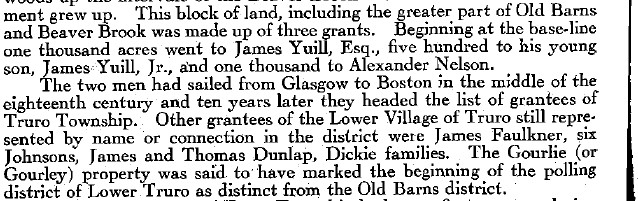
Chronicling Truro Township land grants
Eda Maud Nelson (1884-1980) was a 2nd cousin 2x removed from me and a school teacher, as were most unmarried women born in that era, but she also had an avid interest in local history, and wrote in her local newspaper, the Truro Daily News, in Colchester, Nova Scotia.
Here is one of her articles that goes into some detail about the original Truro Township land grants, after the fall of the Fortress of Louisbourg in 1758. I first mention my ancestor Alexander Nelson's own land grant, which is mentioned in the article, here.
Eda's article is full of all sorts of information. She doesn't actually call the settlers New England Planters, but that is what they were. While Alexander received his land grant in 1761, it turns out that it was officially signed until 1765, something that Eda notes was not uncommon. Some grantees responded to ads Nova Scotia's British Governor placed in New England newspapers. Others received the land grants for military service at the Plains of Abraham or elsewhere.
It's not clear when this story was published, but it was definitely in the age of the once dreaded, now obsolete, library card index system. Eda must have had to do considerable paper research, and this would have take lots of time on her part.
Eda never married, by the way. She and two of her also unmarried sisters are buried together under one marker.
Eda and my common ancestors are my 3rd great grandparents, Elias Nelson (1783-1871) and Elizabeth Forbes (1786-1877). They were her great grandparents.
The never ending story continues....
© Margaret Dougherty 2016-2019 All rights reserved
Here is one of her articles that goes into some detail about the original Truro Township land grants, after the fall of the Fortress of Louisbourg in 1758. I first mention my ancestor Alexander Nelson's own land grant, which is mentioned in the article, here.
Eda's article is full of all sorts of information. She doesn't actually call the settlers New England Planters, but that is what they were. While Alexander received his land grant in 1761, it turns out that it was officially signed until 1765, something that Eda notes was not uncommon. Some grantees responded to ads Nova Scotia's British Governor placed in New England newspapers. Others received the land grants for military service at the Plains of Abraham or elsewhere.
It's not clear when this story was published, but it was definitely in the age of the once dreaded, now obsolete, library card index system. Eda must have had to do considerable paper research, and this would have take lots of time on her part.
![]() |
| Courtesy of Karen Nelson |
Eda never married, by the way. She and two of her also unmarried sisters are buried together under one marker.
Eda and my common ancestors are my 3rd great grandparents, Elias Nelson (1783-1871) and Elizabeth Forbes (1786-1877). They were her great grandparents.
The never ending story continues....
© Margaret Dougherty 2016-2019 All rights reserved
Thursday, 11 July 2019
Alexander Nelson (1737-1803), pioneer of Old Barns
Updated 16 July 2019
I first mentioned my 4x great grandfather, Alexander Nelson (abt 1837-1803) in this early blog post. Alexander settled in Old Barns, which was in Truro Township, Nova Scotia, having received a Crown land grant.
Among the files I've received recently from a new-found cousin is this extract of an article written by Rev John W. Nelson in about 1900 (I'm probably related to him, but that is research that remains to be done), that was part of a larger manuscript now in the Nova Scotia Archives (and I absolutely want to know more that manuscript). It tells more about Alexander and his wife, my 4x great grandmother, Margaret Robinson (1735-1823). I am especially pleased with what I take as official, albeit still anecdotal, confirmation of Alexander's service under General Wolfe at the Plains of Abraham in 1759, which comes from his grandson, who "was positive" about that fact. See the second paragraph here:
This extract tells us for the first time that Alexander had at least two brothers who also came from Scotland to New England. This will open up new research for Alexander's parentage in Scotland, not to mention his brothers who joined him in America.
The extract also gives us insight into Alexander as a man.
The Miller book mentioned in the extract refers to the 1873 book by Thomas Miller, First Settlers of Colchester County (N.S.) Below the title is added: down to the present time. Compiled from the most authentic sources. Chapter 12 of the book is about the Nelson family.
In the early 2000s, I provided my own family's descent from Alexander and Margaret to a Colchester historian, Jane Wile, who self-published Descendants of Alexander Nelson & Margaret Robinson of Truro Township, Nova Scotia in 2006. Jane begins her compilation with this:
I have seen unsupported references online suggesting that Alexander Nelson was at the second siege of Louisbourg on Cape Breton in 1758. The Fortress of Louisbourg confirmed to me recently that their historian has no record of an Alexander Nelson at that event.
Alexander received his Old Barns land grant in 1761. He returned to Massachusetts over that winter, and in the spring, married Margaret. Did he know her before he went to Nova Scotia? Or did they meet when he returned from there?
I've found supporting sources for Alexander and Margaret's Massachusetts marriage on 15 Apr 1762, which was recorded in town registers of Milton, where Alexander lived, and Dunstable, where Margaret lived. I think that soon after they married, Alexander and Margaret made their way to their Crown land grant in Truro Township, Nova Scotia.
All of their 13 children were born in Nova Scotia:
© Margaret Dougherty 2016-2019 All rights reserved
I first mentioned my 4x great grandfather, Alexander Nelson (abt 1837-1803) in this early blog post. Alexander settled in Old Barns, which was in Truro Township, Nova Scotia, having received a Crown land grant.
Among the files I've received recently from a new-found cousin is this extract of an article written by Rev John W. Nelson in about 1900 (I'm probably related to him, but that is research that remains to be done), that was part of a larger manuscript now in the Nova Scotia Archives (and I absolutely want to know more that manuscript). It tells more about Alexander and his wife, my 4x great grandmother, Margaret Robinson (1735-1823). I am especially pleased with what I take as official, albeit still anecdotal, confirmation of Alexander's service under General Wolfe at the Plains of Abraham in 1759, which comes from his grandson, who "was positive" about that fact. See the second paragraph here:
![]() |
| courtesy of Karen Nelson |
The extract also gives us insight into Alexander as a man.
The Miller book mentioned in the extract refers to the 1873 book by Thomas Miller, First Settlers of Colchester County (N.S.) Below the title is added: down to the present time. Compiled from the most authentic sources. Chapter 12 of the book is about the Nelson family.
In the early 2000s, I provided my own family's descent from Alexander and Margaret to a Colchester historian, Jane Wile, who self-published Descendants of Alexander Nelson & Margaret Robinson of Truro Township, Nova Scotia in 2006. Jane begins her compilation with this:
I have seen unsupported references online suggesting that Alexander Nelson was at the second siege of Louisbourg on Cape Breton in 1758. The Fortress of Louisbourg confirmed to me recently that their historian has no record of an Alexander Nelson at that event.
Alexander received his Old Barns land grant in 1761. He returned to Massachusetts over that winter, and in the spring, married Margaret. Did he know her before he went to Nova Scotia? Or did they meet when he returned from there?
![]() |
| from Old Barns, Clifton and Princeport area by Eda M. Nelson, 1908 |
I've found supporting sources for Alexander and Margaret's Massachusetts marriage on 15 Apr 1762, which was recorded in town registers of Milton, where Alexander lived, and Dunstable, where Margaret lived. I think that soon after they married, Alexander and Margaret made their way to their Crown land grant in Truro Township, Nova Scotia.
![]() |
| Massachusetts, Town Vital Collections, 1620-1988 |
All of their 13 children were born in Nova Scotia:
- Elizabeth 1763-
- William Montague 1765-1842
- Agnes 1767-1805
- Archibald 1768-1861
- Charles 1771-1847
- John 1772-1857
- James 1773-1858
- Robinson 1774-1850
- Jane 1775
- Margaret 1779-1826
- Alexander 1781-1839
- Elias 1783-1871 (my 3x great grandfather)
- Alice 1785-
- Rebecca 1787-1818
Initially, I wrote that they had at least 12 children. Since starting my blog, I've found a confirmed 13th child. As you can imagine, Alexander and Margaret had many, many, many grandchildren.
The never ending story continues....
© Margaret Dougherty 2016-2019 All rights reserved
Saturday, 6 July 2019
How Old Barns got its name
Old Barns, where my paternal 4th great grandfather, Alexander Nelson (abt 1737-1803), settled in Colchester, Nova Scotia, was originally farmland of Acadians expelled from Nova Scotia and New Brunswick beginning in 1755.
The area is described vividly in this extract from an unknown source:
![]() |
| Nelson family papers from Nova Scotia Archives |
![]() |
| Nelson family papers from Nova Scotia Archives |
The never ending story continues....
© Margaret Dougherty 2016-2019 All rights reserved
Friday, 28 June 2019
Charlotte Butler Nelson memorial window dedicated at First Baptist Church 2
As I said in my post here about the church stained glass window dedicated to my great
grandmother, in all the references I found about this, she is referred to as Mrs Elias Nelson.

When I contacted the First Baptist Church in Truro hoping to have a photo of
the window, I referred to my great grandmother as Charlotte Butler Nelson. They had trouble finding anything until I sent them an excerpt from the dedication service program and a newspaper story about the event.
Success. I soon received two photos. You can see why they had trouble finding the window.
It's a beautiful window that remains installed in First Baptist Church to this day, almost 53 years after it was dedicated.
I'm glad that women are now known by their own names, and not those of their husbands, and understand that it was different era, but it really wasn't that long ago.
The never ending story continues....
© Margaret Dougherty 2016-2018 All rights reserved
Sunday, 23 June 2019
Charlotte Butler Nelson memorial window dedicated at First Baptist Church 1
| photo courtesy of Karen Nelson |
My Nova Scotia great grandmother, Charlotte Butler Nelson, was a devout Baptist. She joined the First Baptist Church in Truro in 1886, and remained an active member of the congregation for the rest of her days -- that would be 60 years in all.
In 1966, 20 years after her death, Charlotte's son Robert donated a stained glass window depicting the Resurrection to the First Baptist Church in her memory. As was the practice of the time, in all references to this event, she is referred to as Mrs Elias Nelson. Times changed.
![]() |
| Truro Daily News |
The window was dedicated at the church is a special service on 10 Jul 1966, and reported on in the Truro Daily News.
Sadly, I don't think the window is installed any longer. I've contacted the church on Facebook, hoping to have a photo of the window. I provided them the story you see here, together with the dedication service program.
They're still looking. What happened to the window, I wonder?
The never ending story continues....
© Margaret Dougherty 2016-2019 All rights reserved
Sunday, 16 June 2019
Elias Nelson and Charlotte Butler celebrate their 60th wedding anniversary
Updated 17 Jul 2019
My second great grandparents, Elias Nelson and Charlotte Butler, lived long lives, as I recounted here in 2016.
A cousin recently sent me the story below, published on the remarkable occasion of their 60th wedding anniversary in February 1937. The story tells me more about their lives than what is written about them in their respective obituaries in 1942 and 1946.
I learned that Elias lost his leg in an accident in the Truro railroad yard in 1913. I never knew that. My cousin tells me that he hated his artificial leg, and rarely wore it. I can only imagine how uncomfortable and heavy artificial legs were in the early 20th century. When he lost his leg in 1913, Elias was 59 years old. He was in his 92nd year when he died in 1946. How difficult the rest of his life must have been.
As an employee of the Canadian National Railway, Elias was able to travel by train at a discount. Charlotte was also able to travel on his pass too.
While they were married by a Presbyterian minister on 15 Feb 1877, Elias was a lifelong Anglican, while Charlotte was a devout Baptist. As their children grew up, each adopted either the Anglican or Baptist traditions. I suppose the Presbyterian minister was a neutral territory decision, perhaps?
The Nelson homestead referred to in the story was originally in Salmon River. It is where my grandmother and all of her siblings were born. Yes, Elias and Charlotte lived at the same address from 1877. Elias may have been born there. At some point after 1921, Salmon River was absorbed into Truro proper.
The photo of the house (see left) was taken in 1968. The original structure had been added on to, more than once, over the years. As of July 2019, the house is still standing.
The never ending story continues ....
© Margaret Dougherty 2016-2019 All rights reserved
My second great grandparents, Elias Nelson and Charlotte Butler, lived long lives, as I recounted here in 2016.
A cousin recently sent me the story below, published on the remarkable occasion of their 60th wedding anniversary in February 1937. The story tells me more about their lives than what is written about them in their respective obituaries in 1942 and 1946.
| Truro Daily News, February 1937 |
As an employee of the Canadian National Railway, Elias was able to travel by train at a discount. Charlotte was also able to travel on his pass too.
While they were married by a Presbyterian minister on 15 Feb 1877, Elias was a lifelong Anglican, while Charlotte was a devout Baptist. As their children grew up, each adopted either the Anglican or Baptist traditions. I suppose the Presbyterian minister was a neutral territory decision, perhaps?
![]() |
| photo courtesy of Karen Nelson |
The Nelson homestead referred to in the story was originally in Salmon River. It is where my grandmother and all of her siblings were born. Yes, Elias and Charlotte lived at the same address from 1877. Elias may have been born there. At some point after 1921, Salmon River was absorbed into Truro proper.
The photo of the house (see left) was taken in 1968. The original structure had been added on to, more than once, over the years. As of July 2019, the house is still standing.
![]() |
| Google Street View July 2015 |
The never ending story continues ....
© Margaret Dougherty 2016-2019 All rights reserved
Friday, 14 June 2019
Whatever happened to Horatio Nelson?
Updated 26 March 2020
No, not that Horatio Nelson.
My Nova Scotia great grandfather, Elias Nelson (1854-1946) had an older brother, Horatio, who according to the 1871 census was born about 1848, making him six years older than Elias. I've no doubt that my 2nd great grandparents Charles Nelson (1812-1892) and Sarah Anne Forbes (1819-1889) had other children, but we know only of these two sons.
When the 1861 census was collected in Nova Scotia, only the names of household heads were recorded, with just the number of males and females and the total number of people in each household. The 1871 census is the only record we have of Horatio, who appears as a 23 year old.
At some point after 1871, family lore is that Horatio "ran away from home and was never heard from again". There may have been an incident where he got into some sort of trouble, and that sent the sheriff to his parents' farmhouse. Family lore is that Horatio's father, Charles, put his axe in the middle of the door step and said something along the lines of the first person who crossed the doorstep would have to deal with him. These words and the axe were apparently enough to send the sheriff on his way. Soon afterwards, Horatio disappeared.
Let's face it. Disappearing before the mid-20th century was a remarkably easy thing to do for anyone. No one left any digital footprint after all. Statutory births, marriages and deaths were hardly consistently universal in what became Canada. Disappearing ancestors are a thing in my family history. I have a 2nd great aunt who disappeared from her family farm in Quebec's Eastern Townships after the 1861 census.
Did he ever write to his parents or brother to let them know where he was? We don't know. If he did, they took that secret with them to their graves. Did he go out west where so many Nova Scotia men went in the late 19th century? Or did he go to the US, where so many Nova Scotians went? He probably changed his name. After all, in the 19th century, how many Nelson parents named a son Horatio in honour of Lord Nelson and his victory at the Battle of Trafalgar in 1805? There were many Horatio Nelsons, trust me. I've done a lot of research over the years, trying to find out what happened to my great uncle Horatio.
Through AncestryDNA, I recently connected with a 2nd cousin, who is a granddaughter of the only brother of my grandmother, Alice Elizabeth Nelson.
My new cousin shared the tintype picture you see here of Horatio, in which he looks like a young man -- perhaps anywhere from 17.
He was a very good looking young man, wasn't he?
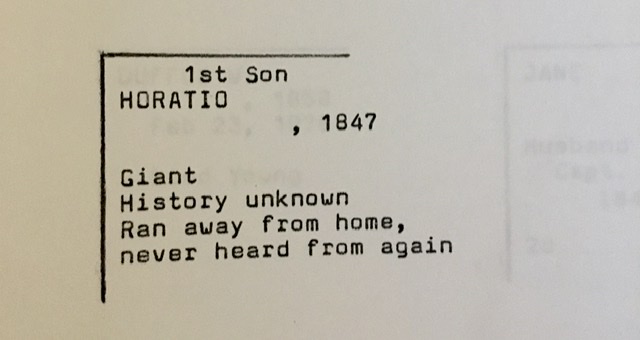
Update: After writing this, I received a partial Nelson family history book compiled in the 1980s/1990s. I say partial because it covers primarily the descendants of the sons of Alexander Nelson, and of those, only those who remained in Colchester, Nova Scotia. The entry in that book for Horatio is brief. But note the word “giant”. I don’t imagine Horatio was a true giant, the stuff of fairy tales or fantasies like the Game of Thrones books or epic series. No, he was probably a tall man, over six feet. Perhaps 6’5”? Who knows. It must have been very hard for a tall man like Horatio to just disappear.
The never ending story continues....
© Margaret Dougherty 2016-2019 All rights reserved
No, not that Horatio Nelson.
My Nova Scotia great grandfather, Elias Nelson (1854-1946) had an older brother, Horatio, who according to the 1871 census was born about 1848, making him six years older than Elias. I've no doubt that my 2nd great grandparents Charles Nelson (1812-1892) and Sarah Anne Forbes (1819-1889) had other children, but we know only of these two sons.
When the 1861 census was collected in Nova Scotia, only the names of household heads were recorded, with just the number of males and females and the total number of people in each household. The 1871 census is the only record we have of Horatio, who appears as a 23 year old.
![]() |
| 1871 Census, Truro, Nova Scotia |
At some point after 1871, family lore is that Horatio "ran away from home and was never heard from again". There may have been an incident where he got into some sort of trouble, and that sent the sheriff to his parents' farmhouse. Family lore is that Horatio's father, Charles, put his axe in the middle of the door step and said something along the lines of the first person who crossed the doorstep would have to deal with him. These words and the axe were apparently enough to send the sheriff on his way. Soon afterwards, Horatio disappeared.
![]() |
| Horatio Nelson, Salmon River, Nova Scotia |
Did he ever write to his parents or brother to let them know where he was? We don't know. If he did, they took that secret with them to their graves. Did he go out west where so many Nova Scotia men went in the late 19th century? Or did he go to the US, where so many Nova Scotians went? He probably changed his name. After all, in the 19th century, how many Nelson parents named a son Horatio in honour of Lord Nelson and his victory at the Battle of Trafalgar in 1805? There were many Horatio Nelsons, trust me. I've done a lot of research over the years, trying to find out what happened to my great uncle Horatio.
Through AncestryDNA, I recently connected with a 2nd cousin, who is a granddaughter of the only brother of my grandmother, Alice Elizabeth Nelson.
My new cousin shared the tintype picture you see here of Horatio, in which he looks like a young man -- perhaps anywhere from 17.
He was a very good looking young man, wasn't he?
Update: After writing this, I received a partial Nelson family history book compiled in the 1980s/1990s. I say partial because it covers primarily the descendants of the sons of Alexander Nelson, and of those, only those who remained in Colchester, Nova Scotia. The entry in that book for Horatio is brief. But note the word “giant”. I don’t imagine Horatio was a true giant, the stuff of fairy tales or fantasies like the Game of Thrones books or epic series. No, he was probably a tall man, over six feet. Perhaps 6’5”? Who knows. It must have been very hard for a tall man like Horatio to just disappear.
The never ending story continues....
© Margaret Dougherty 2016-2019 All rights reserved
Wednesday, 26 April 2017
DNA brings more Nelson connections
When I returned from my offline and out of the country vacation a week ago, I was intent upon resuming posts to this blog with gusto. But then I found a message with the subject line "how are we related?" waiting in my Ancestry message box. We are AncestryDNA matches, but the person didn't at that point have a family tree. She wondered if we are linked either through her mother's midwest Scandinavian families or her father's New England families.
Since I have no American midwest relatives of Scandinavian ancestry, we soon determined that we're related through our fathers. Her father was a Nelson, and because his parents' marriage was an old fashioned shotgun wedding in the Boston area, she knew absolutely nothing about his family. My latest cousin had her paternal grandparents and great grandparents' names and knew that her great grandfather, Arthur Hamilton Nelson (1874-1952) had been born in Nova Scotia, but not much more.
You know what happened next. Rather than getting back to blogging, I instead spent several hours over three days unravelling this latest DNA cousin's ancestry and her link to me. I love nothing more than a good genealogy mystery.
I was able to tell this latest DNA cousin more of her Colchester, Nova Scotia and New England Planter roots, and she has now begun baby steps to populating her tree. We are 5th cousins once removed. We both descend from my 4th great grandparents Alexander Nelson (abt 1737-1803) and Margaret Robinson (1735-1823), but my new cousin descends twice from them, through two of their sons, Charles Nelson (1771-1847) and Robinson Nelson (1774-1850), who are older brothers to my 3rd great grandfather, Elias Nelson (1783-1871). with Alexander and Margaret my cousin's 4th great grandparents.
My new cousin now know that there are thousands of Nelson cousins across North America (at least),and has much work ahead of her, learning more about genealogy and populating her family tree. But I don't want to scare her off from experiencing the passion of genealogy, so I'm trying very hard not to bombard her with information.
Like for instance, not all Nelsons descend from our great grandparents. Like there's are separate Nelson lines that originated on Prince Edward Island via Philadelphia in the early 19th century that is probably originally from England, whereas the Nova Scotia Nelsons are Scots in origin.
The never ending story continues....
© Margaret Dougherty 2016-2017 All rights reserved
Since I have no American midwest relatives of Scandinavian ancestry, we soon determined that we're related through our fathers. Her father was a Nelson, and because his parents' marriage was an old fashioned shotgun wedding in the Boston area, she knew absolutely nothing about his family. My latest cousin had her paternal grandparents and great grandparents' names and knew that her great grandfather, Arthur Hamilton Nelson (1874-1952) had been born in Nova Scotia, but not much more.
You know what happened next. Rather than getting back to blogging, I instead spent several hours over three days unravelling this latest DNA cousin's ancestry and her link to me. I love nothing more than a good genealogy mystery.
I was able to tell this latest DNA cousin more of her Colchester, Nova Scotia and New England Planter roots, and she has now begun baby steps to populating her tree. We are 5th cousins once removed. We both descend from my 4th great grandparents Alexander Nelson (abt 1737-1803) and Margaret Robinson (1735-1823), but my new cousin descends twice from them, through two of their sons, Charles Nelson (1771-1847) and Robinson Nelson (1774-1850), who are older brothers to my 3rd great grandfather, Elias Nelson (1783-1871). with Alexander and Margaret my cousin's 4th great grandparents.
My new cousin now know that there are thousands of Nelson cousins across North America (at least),and has much work ahead of her, learning more about genealogy and populating her family tree. But I don't want to scare her off from experiencing the passion of genealogy, so I'm trying very hard not to bombard her with information.
Like for instance, not all Nelsons descend from our great grandparents. Like there's are separate Nelson lines that originated on Prince Edward Island via Philadelphia in the early 19th century that is probably originally from England, whereas the Nova Scotia Nelsons are Scots in origin.
The never ending story continues....
© Margaret Dougherty 2016-2017 All rights reserved
Wednesday, 19 October 2016
Letitia Olive Nelson (1880-1941) lived abroad
You learn so much from reading old newspaper death notices. Often, they fill in blanks that you had for one or more ancestors.
Recently, I asked the Halifax Public Library to check for newspaper death notices for my grandmother's four siblings. Unfortunately, they found a notice for only one of them, but what great information it revealed.
I had been able to find no record of Letitia Olive Nelson after the 1901 census, when she was recorded as living with her parents in Truro, Nova Scotia.
I knew years ago from an aunt and uncle that Letitia had never married, and that she had a strong personality. Okay, I recall the words battle axe being used. This was all that I knew.
The newspaper notice that was in my mail this week reveals that like my grandmother, Letitia was also a registered nurse, and that she had worked in the U.S. for 30 years. Armed with this new information, back I went into research mode. I quickly found city directories and census listings showing that she had lived in Washington DC since soon after the 1901 Canadian census. I also found passenger lists recording her ship passages between Nova Scotia and New York through the years, as she returned for family visits.
According to censuses, Letitia was a nurse "on her own account", perhaps what we call today freelance. Did that mean she was a private nurse?
Clearly, Letitia was an independent woman, something still unusual for that time. What drew her to Washington? Were there relatives? Many Nova Scotians went to Massachusetts or Maine for work. 'Twas ever thus. These were closer to Nova Scotia than Washington. It was unusual to settle in Washington.
What sort of life did Letitia lead? Did she have adventures? Washington must have been an interesting place to be, through the First World War and then the Roaring Twenties and Prohibition. Despite spending 30 years living there, Letitia decided to return to Nova Scotia when she retired at the relatively early age of about 52.
I wonder why Letitia chose to be buried in Wolfville, rather than Truro, with her family. Perhaps this was because she predeceased both her parents, Charlotte and Elias, like her sister Loie (Lophemia) Nelson Purdy (1891-1930).
I always feel a sense of satisfaction with finds like these. It is like finding a missing relative and bringing them back among family.
You'll note that the notice here identifies my grandmother as Mrs Joseph Dougherty. This was because for reasons unknown to me, my grandfather John James Dougherty (1879-1953) had always been called Joe.
The never ending story continues....
Recently, I asked the Halifax Public Library to check for newspaper death notices for my grandmother's four siblings. Unfortunately, they found a notice for only one of them, but what great information it revealed.I had been able to find no record of Letitia Olive Nelson after the 1901 census, when she was recorded as living with her parents in Truro, Nova Scotia.
I knew years ago from an aunt and uncle that Letitia had never married, and that she had a strong personality. Okay, I recall the words battle axe being used. This was all that I knew.
The newspaper notice that was in my mail this week reveals that like my grandmother, Letitia was also a registered nurse, and that she had worked in the U.S. for 30 years. Armed with this new information, back I went into research mode. I quickly found city directories and census listings showing that she had lived in Washington DC since soon after the 1901 Canadian census. I also found passenger lists recording her ship passages between Nova Scotia and New York through the years, as she returned for family visits.
According to censuses, Letitia was a nurse "on her own account", perhaps what we call today freelance. Did that mean she was a private nurse?
Clearly, Letitia was an independent woman, something still unusual for that time. What drew her to Washington? Were there relatives? Many Nova Scotians went to Massachusetts or Maine for work. 'Twas ever thus. These were closer to Nova Scotia than Washington. It was unusual to settle in Washington.
What sort of life did Letitia lead? Did she have adventures? Washington must have been an interesting place to be, through the First World War and then the Roaring Twenties and Prohibition. Despite spending 30 years living there, Letitia decided to return to Nova Scotia when she retired at the relatively early age of about 52.
I wonder why Letitia chose to be buried in Wolfville, rather than Truro, with her family. Perhaps this was because she predeceased both her parents, Charlotte and Elias, like her sister Loie (Lophemia) Nelson Purdy (1891-1930).
I always feel a sense of satisfaction with finds like these. It is like finding a missing relative and bringing them back among family.
You'll note that the notice here identifies my grandmother as Mrs Joseph Dougherty. This was because for reasons unknown to me, my grandfather John James Dougherty (1879-1953) had always been called Joe.
The never ending story continues....
Saturday, 8 October 2016
Our immigrant ancestors -- Thomas Butler (1781-aft 1819)
Much of my 3rd great grandfather Thomas Butler's life after his marriage on 7 Apr 1806 in Massachusetts to Mary Southwick (1788-1865) remains a mystery to this day. He wasn't considered part of the New England planter migration and settlement in Nova Scotia -- that era had passed by the time he migrated to Nova Scotia.
Thomas was born on 20 May 1781 in Falmouth on Cape Cod to Captain John Butler (1751-1794) and Parnel (or Pernal) Hatch (abt 1759-1842). He was the eldest of six children.
There is an unproven story passed down that Captain John served in the British Navy and was lost at sea.
At some point after their 1806 marriage, Thomas and Mary arrived in Nova Scotia, initially in Halifax. Was this Thomas a sailor?
Thomas and Mary had perhaps four sons. It's not known whether the two eldest were born in Massachusetts or Nova Scotia. However the marriage certificate of their third son, my 2nd great grandfather Samuel (1816-1887) to his second wife, Esther Lawson, notes that he was born in Halifax.
Thomas may have died around 1819, but documentation for that is difficult to find. His widow Mary remained in Upper Stewiacke, no doubt to be near her son and grandchildren, until she died in 1865.
I've traced Thomas' ancestry back five generations, to another Thomas Butler (abt 1617-abt 1689), who was born in England, and arrived in New England in about 1637, settling in Sandwich on Cape Cod. We don't know where in England that first Thomas was born.
There is another old Butler family in Massachusetts, this one on Martha's Vineyard, where the first recorded there was a Nicholas Butler (abt 1588-1671). There is no proven link between Nicholas of Martha's Vineyard and Thomas of Cape Cod, but perhaps Nicholas was a nephew? One of Nicholas' Martha's Vineyard descendants -- yet another Thomas Butler (1654-1732) -- married a 1st cousins 9x removed of mine, Jemima Daggett (abt 1666-?), granddaughter of Governor Thomas Mayhew, who was the second immigrant ancestor that I profiled here.
There are many unsolved mysteries with this immigrant ancestor. Hopefully, there are records yet to be found in both Cape Cod and Nova Scotia that will explain all....eventually.
The never ending story continues....
![]() |
| Massachusetts Vital Records |
There is an unproven story passed down that Captain John served in the British Navy and was lost at sea.
At some point after their 1806 marriage, Thomas and Mary arrived in Nova Scotia, initially in Halifax. Was this Thomas a sailor?
Thomas and Mary had perhaps four sons. It's not known whether the two eldest were born in Massachusetts or Nova Scotia. However the marriage certificate of their third son, my 2nd great grandfather Samuel (1816-1887) to his second wife, Esther Lawson, notes that he was born in Halifax.
Thomas may have died around 1819, but documentation for that is difficult to find. His widow Mary remained in Upper Stewiacke, no doubt to be near her son and grandchildren, until she died in 1865.
I've traced Thomas' ancestry back five generations, to another Thomas Butler (abt 1617-abt 1689), who was born in England, and arrived in New England in about 1637, settling in Sandwich on Cape Cod. We don't know where in England that first Thomas was born.
There is another old Butler family in Massachusetts, this one on Martha's Vineyard, where the first recorded there was a Nicholas Butler (abt 1588-1671). There is no proven link between Nicholas of Martha's Vineyard and Thomas of Cape Cod, but perhaps Nicholas was a nephew? One of Nicholas' Martha's Vineyard descendants -- yet another Thomas Butler (1654-1732) -- married a 1st cousins 9x removed of mine, Jemima Daggett (abt 1666-?), granddaughter of Governor Thomas Mayhew, who was the second immigrant ancestor that I profiled here.
There are many unsolved mysteries with this immigrant ancestor. Hopefully, there are records yet to be found in both Cape Cod and Nova Scotia that will explain all....eventually.
The never ending story continues....
Wednesday, 5 October 2016
Lives lived (but the details are sometimes fuzzy)
My Nova Scotia great grandparents both died after living long lives in the 1940s. Charlotte Butler Nelson (1854-1942) predeceased my great grandfather Elias Nelson (1854-1946). Two confusing and error-riddled funeral notices for Charlotte appeared, one following the other, in the Truro Daily News on 15 May 1942 five days after her death.
Very little fact checking seems to have been done once these two stories were filed. Charlotte's middle name wasn't Moore. This was a family name on Elias' side, not on Charlotte's side. My 2nd great grandmother, Charlotte's mother, was Mary Olive Fisher (abt 1819-1865), not Alice Fisher. Yet, perhaps she was known as Alice, and perhaps that's why my grandmother was called Alice. Certainly, that name wasn't seen in either the Butlers or the Nelsons until my grandmother came along. Since Charlotte lost her mother when she was just ten or 11 years old, this too could account for her mother's name discrepancy.
Charlotte was born on 3 Sep 1853. It was Elias who was born on 17 Aug 1854. Listed as her surviving children are her son Robert and daughters Emma and Alice. Except my grandmother is identified as Mrs Alice Purdy of Great Village, instead of Mrs Alice Dougherty of Montreal. Two of Charlotte's daughters (my great aunts) Loie Nelson Purdy (1891-1930) and Letitia Nelson (1880-1941) preceded her in death.
Phew! Those are a lot of mistakes. When you lose a loved one, it can be hard enough. But to have the details so thoroughly muddled in print, and then never corrected (I haven't found any correction) definitely would rub salt in the wound for her loved ones.
Still, Charlotte's obituary did give me new information -- that she had moved to Truro to act as housekeeper for her brother, after his wife had passed away in 1873. In time, she and Elias met. They were married in Truro on 15 Feb 1877. When Charlotte died in 1942 , they had been married 65 years. A milestone to be sure.
When Elias died four years later, all of the details were correctly reported in the Truro Daily News (see right). I suppose the newspaper wanted to make sure of the facts in 1946.
As you can see, the causes of Charlotte and Elias' deaths weren't reported. In Charlotte's case, it was bronchial pneumonia and influenza, while the cause of death recorded for Elias was senility.
Charlotte was a Baptist, while Elias was Anglican. Their children were all raised as Baptists.
The never ending story continues....
Very little fact checking seems to have been done once these two stories were filed. Charlotte's middle name wasn't Moore. This was a family name on Elias' side, not on Charlotte's side. My 2nd great grandmother, Charlotte's mother, was Mary Olive Fisher (abt 1819-1865), not Alice Fisher. Yet, perhaps she was known as Alice, and perhaps that's why my grandmother was called Alice. Certainly, that name wasn't seen in either the Butlers or the Nelsons until my grandmother came along. Since Charlotte lost her mother when she was just ten or 11 years old, this too could account for her mother's name discrepancy.
Charlotte was born on 3 Sep 1853. It was Elias who was born on 17 Aug 1854. Listed as her surviving children are her son Robert and daughters Emma and Alice. Except my grandmother is identified as Mrs Alice Purdy of Great Village, instead of Mrs Alice Dougherty of Montreal. Two of Charlotte's daughters (my great aunts) Loie Nelson Purdy (1891-1930) and Letitia Nelson (1880-1941) preceded her in death.
Phew! Those are a lot of mistakes. When you lose a loved one, it can be hard enough. But to have the details so thoroughly muddled in print, and then never corrected (I haven't found any correction) definitely would rub salt in the wound for her loved ones.
Still, Charlotte's obituary did give me new information -- that she had moved to Truro to act as housekeeper for her brother, after his wife had passed away in 1873. In time, she and Elias met. They were married in Truro on 15 Feb 1877. When Charlotte died in 1942 , they had been married 65 years. A milestone to be sure.
When Elias died four years later, all of the details were correctly reported in the Truro Daily News (see right). I suppose the newspaper wanted to make sure of the facts in 1946.As you can see, the causes of Charlotte and Elias' deaths weren't reported. In Charlotte's case, it was bronchial pneumonia and influenza, while the cause of death recorded for Elias was senility.
Charlotte was a Baptist, while Elias was Anglican. Their children were all raised as Baptists.
The never ending story continues....
Saturday, 1 October 2016
Our immigrant ancestors -- Hugh Calkins (abt 1603-1690)
![]() |
| Immigrant Ancestors listing |

Hugh is one of dozens of my immigrant ancestors listed in my favourite little reference book. As noted there, Hugh was one of the founders of Gloucester, Massachusetts. He and his wife Ann (last name unknown) had at least nine children, the youngest of whom were born in New England. Through his children, he has many descendants across North America today.
William Cutter writes in his 1910 book, Genealogical and Personal Memoirs Relating to the Families of the State of Massachusetts, "Hugh Calkins was a radical, in religion a non-conformist, and living in the troublous times of Charles, the First, soon became satisfied that there were safer countries than England and Wales—for men who wished to worship God according to the dictates of their own consciences. Accordingly, he with his wife, Ann, and John, their son, then four years old, joined a body of emigrants called the 'Welch Company,' and with their pastor, Rev. Richard Blinman, embarked and came to America, about 1638 or 1640.” Does this mean he was a Puritan? I don't know.
Hugh was born in Cheshire, the English county that borders on Wales, and was christened on 3 Apr 1603 in Waverton, Cheshire, England. We know from his christening record that his father's name was Rowland.
His son, my 8th great grandfather John Calkins (1634-1703), was one of the founders of Norwich, Connecticut in 1659. His name, together with the other town founders, is listed on a monument in Founders Cemetery there.
At some point, the "s" was dropped in the family name. Hugh's great grandson (and my 6th great grandfather), Jeremiah Calkin (1705-aft 1770) migrated from New England to Nova Scotia as a New England Planter as a widower, with his family in about 1760. Jeremiah had been married to Rachel Janes (1700-bef 1760) in Connecticut in 1725, and they had at least five children.
Jeremiah's house still stands today in Kings, Nova Scotia. Jeremiah's daughter (and my 5th great grandmother), Lucy, migrated to Nova Scotia separately with her husband Jonathan Godfrey, as I noted here.
The more you research, the more you know. Early on, I was thrilled to discover Hugh Calkins because, based on what I initially read, I thought that I had Welsh ancestry. Sigh. But the more I researched I learned that he was an Englishman.
The never ending story continues....
His son, my 8th great grandfather John Calkins (1634-1703), was one of the founders of Norwich, Connecticut in 1659. His name, together with the other town founders, is listed on a monument in Founders Cemetery there.
At some point, the "s" was dropped in the family name. Hugh's great grandson (and my 6th great grandfather), Jeremiah Calkin (1705-aft 1770) migrated from New England to Nova Scotia as a New England Planter as a widower, with his family in about 1760. Jeremiah had been married to Rachel Janes (1700-bef 1760) in Connecticut in 1725, and they had at least five children.
Jeremiah's house still stands today in Kings, Nova Scotia. Jeremiah's daughter (and my 5th great grandmother), Lucy, migrated to Nova Scotia separately with her husband Jonathan Godfrey, as I noted here.
The more you research, the more you know. Early on, I was thrilled to discover Hugh Calkins because, based on what I initially read, I thought that I had Welsh ancestry. Sigh. But the more I researched I learned that he was an Englishman.
The never ending story continues....
Monday, 26 September 2016
The Nova Scotia roots weekend
I spent this past weekend in Nova Scotia, to attend the annual meeting of the Nova Scotia Colony of Mayflower Descendants in Digby. There was a great write-up about the colony and the large number of Nova Scotia Mayflower descendants in the Halifax Chronicle Herald earlier in the week, generating wonderful attendance on Saturday.Stephen Hopkins is my Mayflower ancestor. His direct descendant and my 6th great grandparent, David Godfrey first arrived in Nova Scotia in about 1761.
After arriving at Halifax early Friday afternoon, I took what I intended to be a leisurely scenic route to my friends in Kentville from the airport, intent on doing some exploring. But it was pouring rain all afternoon, and so while I still did the drive, the scenic part wasn't really that visible at times. I did drive to Great Village (today's population is 500), which is where my father and uncles spent many boyhood summers working on their Nelson grandparents' farm (and giving respite to my grandmother, who had five sons in nine years).
That farmland was the Crown land grant (those seized Acadian lands again) that my New England Planter 4th great grandfather Alexander Nelson received in 1761. At the Colony meeting on Saturday, I learned from an excellent guest speaker that there may be some merit to the story that he fought with General Wolfe at the Plains of Abraham in 1759. I have new leads in the form of muster rolls to explore on that story.
![]() |
| from The Elizabeth Bishop Centenary Blog |
Besides Great Village, on my scenic rainy drive, I saw many place names and family names with which I've grown very familiar through my years of genealogy research. Places like Old Barns and Salmon River. Family names like Archibald and Yuill and so on. Isn't it comforting to be among your ancestors?
The never ending story continues....
Saturday, 17 September 2016
Our immigrant ancestors -- David Godfrey & Priscilla Baker
Continuing to recount my New England ancestors, my 6th great grandparents, David Godfrey (abt 1707-abt 1777) and Priscilla Baker (abt 1710-abt 1777) married on Cape Cod in Chatham on 14 Oct 1731. Through his grandmother Deborah Cooke, David is a 2nd great grandson of Mayflower passengers Stephen Hopkins, and great grandson of Giles Hopkins.
By about 1748, David and Priscilla had moved with their family to Connecticut, where they lived for about 12 or 13 years. They followed their eldest son, a sea captain, also David (1732-1813), to Nova Scotia, as part of the New England Planters' arrival in about 1761, when David received a land grant in Horton, which he farmed. David and Priscilla remained in Nova Scotia for the rest of their lives.
I descend from David and Priscilla's second son, Jonathan (1739-1826) and his wife, Lucy Calkin (1740-1825), who after arriving from Connecticut, lived first in Cornwallis and later, Windsor. They arrived in Nova Scotia about 1766.
There are many Godfrey descendants across North America today, including of course, in Nova Scotia.
The earliest Godfreys are recorded in Eastham, on Cape Cod in the mid 1660s. The first, George Godfrey, arrived there by 1661 from England, married (his wife's name is unknown), and began a family that grew to at least nine children, born between 1663 and 1688.
The never ending story continues...
By about 1748, David and Priscilla had moved with their family to Connecticut, where they lived for about 12 or 13 years. They followed their eldest son, a sea captain, also David (1732-1813), to Nova Scotia, as part of the New England Planters' arrival in about 1761, when David received a land grant in Horton, which he farmed. David and Priscilla remained in Nova Scotia for the rest of their lives.
I descend from David and Priscilla's second son, Jonathan (1739-1826) and his wife, Lucy Calkin (1740-1825), who after arriving from Connecticut, lived first in Cornwallis and later, Windsor. They arrived in Nova Scotia about 1766.
There are many Godfrey descendants across North America today, including of course, in Nova Scotia.
The earliest Godfreys are recorded in Eastham, on Cape Cod in the mid 1660s. The first, George Godfrey, arrived there by 1661 from England, married (his wife's name is unknown), and began a family that grew to at least nine children, born between 1663 and 1688.
The never ending story continues...
Saturday, 10 September 2016
Our Immigrant Ancestors -- the Newcombs of Nova Scotia
Newcomb is an old English family, possibly with Saxon origin, and with many early spelling variations.
The earliest recorded mention in North America of the Newcomb name is in 1630, when a John Newcomen was murdered by Mayflower passenger John Billington, who was tried, convicted and hung for his deed. I haven't found any information about John Newcomen's parents to connect him to my lines, but the murder apparently arose from an old, ongoing dispute. Billington was from Lincolnshire, England, which is also where my main Newcomb line originates. Perhaps that dispute began many years earlier in Lincolnshire.
I have two early Newcomb ancestors in North America. The first is Mabell Newcomen Twyning (or Twining -- the tea people?!), my 11th great grandmother, who probably arrived in Massachusetts Colony with her husband and grown family in the mid 1620s from Gloucestershire. The second is my 10th great grandfather, Capt Andrew Newcomb (abt 1618-abt 1686), a schooner captain, who arrived in Massachusetts from Devon. The earliest mention of him in Massachusetts is in 1663. His son, Lieut. Andrew Newcomb (abt 1640-1708) made his home in Maine, where some of his children were born, but died on Cape Cod in Edgarstown. His son, Simon Newcomb (1666-1745), my 8th great grandfather, settled in Connecticut.
I have three direct Newcomb lines, but only one of these migrated to Nova Scotia. My 7th great grandparents, Simon's son, Deacon John Newcomb (1688-1765) and Alice Lombard (1686-1767) arrived there from Connecticut in 1760, with some of their immediate and two of John's brothers (Simon and Benjamin) and their families, as part of the New England Planters group, settling in Cornwallis. (Yes, several of my early New England and Nova Scotia ancestors were church elders or deacons.) A bit about Deacon John's life can be read here.
I'm descended twice John and Alice: from their son Capt Eddy Newcomb (1713-1781), who married Abigail English (1724-1790) and came with his parents to Cornwallis; and from their daughter Katherine Newcomb (1710-1762), who remained in Connecticut and married Noah Bliss Webster (1706-1762). Eddy and Katherine, and their spouses, are my 6th great grandparents. When Eddy and Abigail arrived, their older children were already young adults.
As Douglas Goff notes in his paper, The Ancestry of Abigail and Elizabeth Newcomb, Capt Eddy "is said to have served as captain under Gov. Cornwallis in the War of the Revolution, and to have been taken prisoner with him and his army, Oct. 19, 1781 (Eaton, Arthur Wentworth Hamilton. 1910. The History of Kings County)."
It's from Capt Andrew that my Nova Scotia Newcombs descend. Let's go back to them. Eddy Newcomb was John and Abigail's eldest son. He was named after his maternal grandmother, Elizabeth Eddy (abt 1663-1710). It's not a nickname for Edward in this case. He, his father Deacon John, his uncles and his brother John Jr were among the original grantees in Cornwallis (those Acadian lands again!) and were farmers.
Eddy and Abigail had nine children, the first six of whom were born in Connecticut. Their eldest child, Elizabeth (1743-1824), is my 5th great grandmother. In 1762, in Cornwallis, she married Eliakim Tupper (1742-1810) who was also part of a New England Planter family originally from Cape Cod. Eliakim and Elizabeth were among the early settlers of Stewiake, in what became Colchester County, before moving to nearby Truro in about 1773. Eliakim kept the only inn there, and became Justice of the Peace for what are today the counties of Colchester and Pictou. Between 1763 and 1780, they had nine children, including six sons and three daughters, including my 4th great grandmother, Mary Tupper Fisher, whom I mention in this post.
Elizabeth and Eliakim returned to Stewiake from Truro in about 1792 their later years, and died there.
In Nova Scotia, and all of Canada today, there are countless Newcomb descendants.
The never ending story continues...
The earliest recorded mention in North America of the Newcomb name is in 1630, when a John Newcomen was murdered by Mayflower passenger John Billington, who was tried, convicted and hung for his deed. I haven't found any information about John Newcomen's parents to connect him to my lines, but the murder apparently arose from an old, ongoing dispute. Billington was from Lincolnshire, England, which is also where my main Newcomb line originates. Perhaps that dispute began many years earlier in Lincolnshire.
I have two early Newcomb ancestors in North America. The first is Mabell Newcomen Twyning (or Twining -- the tea people?!), my 11th great grandmother, who probably arrived in Massachusetts Colony with her husband and grown family in the mid 1620s from Gloucestershire. The second is my 10th great grandfather, Capt Andrew Newcomb (abt 1618-abt 1686), a schooner captain, who arrived in Massachusetts from Devon. The earliest mention of him in Massachusetts is in 1663. His son, Lieut. Andrew Newcomb (abt 1640-1708) made his home in Maine, where some of his children were born, but died on Cape Cod in Edgarstown. His son, Simon Newcomb (1666-1745), my 8th great grandfather, settled in Connecticut.
I have three direct Newcomb lines, but only one of these migrated to Nova Scotia. My 7th great grandparents, Simon's son, Deacon John Newcomb (1688-1765) and Alice Lombard (1686-1767) arrived there from Connecticut in 1760, with some of their immediate and two of John's brothers (Simon and Benjamin) and their families, as part of the New England Planters group, settling in Cornwallis. (Yes, several of my early New England and Nova Scotia ancestors were church elders or deacons.) A bit about Deacon John's life can be read here.
I'm descended twice John and Alice: from their son Capt Eddy Newcomb (1713-1781), who married Abigail English (1724-1790) and came with his parents to Cornwallis; and from their daughter Katherine Newcomb (1710-1762), who remained in Connecticut and married Noah Bliss Webster (1706-1762). Eddy and Katherine, and their spouses, are my 6th great grandparents. When Eddy and Abigail arrived, their older children were already young adults.
As Douglas Goff notes in his paper, The Ancestry of Abigail and Elizabeth Newcomb, Capt Eddy "is said to have served as captain under Gov. Cornwallis in the War of the Revolution, and to have been taken prisoner with him and his army, Oct. 19, 1781 (Eaton, Arthur Wentworth Hamilton. 1910. The History of Kings County)."
It's from Capt Andrew that my Nova Scotia Newcombs descend. Let's go back to them. Eddy Newcomb was John and Abigail's eldest son. He was named after his maternal grandmother, Elizabeth Eddy (abt 1663-1710). It's not a nickname for Edward in this case. He, his father Deacon John, his uncles and his brother John Jr were among the original grantees in Cornwallis (those Acadian lands again!) and were farmers.
Eddy and Abigail had nine children, the first six of whom were born in Connecticut. Their eldest child, Elizabeth (1743-1824), is my 5th great grandmother. In 1762, in Cornwallis, she married Eliakim Tupper (1742-1810) who was also part of a New England Planter family originally from Cape Cod. Eliakim and Elizabeth were among the early settlers of Stewiake, in what became Colchester County, before moving to nearby Truro in about 1773. Eliakim kept the only inn there, and became Justice of the Peace for what are today the counties of Colchester and Pictou. Between 1763 and 1780, they had nine children, including six sons and three daughters, including my 4th great grandmother, Mary Tupper Fisher, whom I mention in this post.
Elizabeth and Eliakim returned to Stewiake from Truro in about 1792 their later years, and died there.
In Nova Scotia, and all of Canada today, there are countless Newcomb descendants.
The never ending story continues...
Monday, 5 September 2016
On this day: the Acadian Expulsion begins
My earliest 18th century Nova Scotia ancestors arrived there from New England, many answering the call of the British government to settle there, as part of the New England Planters. Included in this group was my 4th great grandfather, Alexander Nelson. The lands New England Planters received as Crown land grants were seized lands of deported Acadians. The Globe and Mail has a wonderful feature called A Moment in Time. Today's snapshot recalls that on this day in 1755, the Acadian Expulsion began.
The never ending story continues...
Saturday, 3 September 2016
Our immigrant ancestors -- Samuel A. Fisher (1758-1812)
My 4th paternal great grandfather was Samuel A. Fisher, who was born in Londonderry, New Hampshire in 1758 to Deacon Samuel Fisher and Sarah Barber. In chapter 38 of his 1873 book, Historical and Genealogical Record of the First Settlers of Colchester County, Thomas Miller writes this about of Samuel A.:
Samuel A. arrived in Truro, Colchester, Nova Scotia in about 1767, aged nine, with his older half sister, Janet and her husband Matthew Archibald. He married Mary Tupper (1766-1812), a daughter of Eliakim Tupper and Elizabeth Newcomb in about 1786, and they went on to have ten children, making their home in Upper Stewiake, Colchester, Nova Scotia, where he farmed. In 1791, Samuel A. is recorded in a poll tax roll as residing there.
Samuel A. died on 12 May 1812, following Mary, who predeceased him only weeks earlier on 23 Apr 1812. It is reported in sources that Samuel A. and Mary were the first white people to be buried in Upper Stewiake's Riverside Cemetery, built on land that had originally been an Aboriginal burying ground.
The never ending story continues...
"Samuel, son of Deacon Samuel Fisher, was born in Londonderry, New Hampshire. He removed to Nova Scotia in 1767. He was married to Mary, daughter of Eliakim Tupper, Esq., and Elizabeth Newcomb. He settled on the interval farm that is now owned by Mr. Samuel Butler and Mr. Patterson, on the south side of the Stewiacke River, in 1784. He was a worthy man; he went by the name of Deacon Fisher also. He died in Stewiacke, May 12th, 1812."Miller also writes about the passage of Samuel's father, Deacon Samuel Fisher, my 5th great grandfather from Ireland to America this:
"Deacon Samuel Fisher was born in the North of Ireland, in the year 1722, and was of Scottish descent. His father was a weaver. He came to America in 1740, in the 19th year of his age. The ship in which he came was usually spoken of as "The starved ship". The vessel was so scantily supplied with provisions, that, long before the voyage was completed, one pint of oatmeal for each individual on board, and a proportionate allowance of water, was all that remained. Mr. Fisher once went to the mate with a tablespoon to obtain some water, which was refused him, there being but two-thirds of a bottlefull on board. Mr. Fisher's custom was to take a spoonfull of meal and having moistened it with salt water, to eat it raw. The passengers and crew, having subsisted in this manner for fourteen days, were at length reduced to the necessity of eating the bodies of those who died. Even this resource failed them; and, at length, Mr. Fisher was selected to give up his life to preserve the lives of the rest. Providentially, however, a vessel hove in sight; and their signals of distress being observed, they obtained relief, and he was saved. So deep an impression did the horrors of that passage make upon the mind of Mr. Fisher, that, in after life, he could never see, without pain, the least morsel of food wasted, or a pail of water thrown on the ground carelessly."What a harrowing journey! This story takes my breath away. Deacon Samuel married three times in New Hampshire. Samuel A. is the second son of his final marriage, to Sarah Barber, my 5th great grandmother.
Samuel A. arrived in Truro, Colchester, Nova Scotia in about 1767, aged nine, with his older half sister, Janet and her husband Matthew Archibald. He married Mary Tupper (1766-1812), a daughter of Eliakim Tupper and Elizabeth Newcomb in about 1786, and they went on to have ten children, making their home in Upper Stewiake, Colchester, Nova Scotia, where he farmed. In 1791, Samuel A. is recorded in a poll tax roll as residing there.
Samuel A. died on 12 May 1812, following Mary, who predeceased him only weeks earlier on 23 Apr 1812. It is reported in sources that Samuel A. and Mary were the first white people to be buried in Upper Stewiake's Riverside Cemetery, built on land that had originally been an Aboriginal burying ground.
The never ending story continues...
Saturday, 6 August 2016
Our Immigrant Ancestors -- the New England Planters of Nova Scotia
In addition to my 4th great grandfather Alexander Nelson, all of my Nova Scotia roots come from England, Scotland, Wales and Ireland, via New England, more specifically Massachusetts, New Hampshire and Connecticut.
The first of my ancestors to reach Nova Scotia following Alexander Nelson were also part of the 2,000 families who were New England Planters, arriving between 1759 and 1768, after the Acadian Expulsion. I have New England Planter ancestors who settled in Colchester County and the Annapolis Valley. They were primarily farmers and fishers when they arrived.
These direct ancestors had family names such as Fisher, Forbes, Godfrey, McClane/McLean, Moor, Newcomb, Tupper and Webster. These are names still found in Nova Scotia, more than 200 years later.
Planters is an Elizabethan English term for settlers. After the Acadian Expulsion by the British, notices were published in New England newspapers offering free land to anyone who would go to Nova Scotia to farm land formerly occupied by Acadians.
Canada's seventh prime minister, Sir Charles Tupper, who holds the record for serving the shortest term as prime minister--10 weeks--(there's a good trivia question), led Nova Scotia into Confederation and is one of Canada's Fathers of Confederation, is the descendant of New England Planters. Oh, and he's also my 3rd cousin 5x removed--not necessarily a great trivia question.
Want to know more about the New England Planters?
The first of my ancestors to reach Nova Scotia following Alexander Nelson were also part of the 2,000 families who were New England Planters, arriving between 1759 and 1768, after the Acadian Expulsion. I have New England Planter ancestors who settled in Colchester County and the Annapolis Valley. They were primarily farmers and fishers when they arrived.
These direct ancestors had family names such as Fisher, Forbes, Godfrey, McClane/McLean, Moor, Newcomb, Tupper and Webster. These are names still found in Nova Scotia, more than 200 years later.
Planters is an Elizabethan English term for settlers. After the Acadian Expulsion by the British, notices were published in New England newspapers offering free land to anyone who would go to Nova Scotia to farm land formerly occupied by Acadians.
![]() |
| Sir Charles Tupper |
Want to know more about the New England Planters?
The never ending story continues...
Monday, 18 July 2016
Charlotte Butler & Elias Nelson of Colchester, Nova Scotia
My paternal great grandparents, the parents of Alice Nelson Dougherty, were Charlotte Butler (1853-1942) and Elias Nelson (1854-1946). Elias was a farmer, and the son of Charles Nelson (1812-1892) and Sarah Ann Moore (1819-1889). It's not clear if Elias farmed the land granted to Alexander Nelson. There were after all, many descendants of Alexander still throughout the Colchester, Nova Scotia area in the late 19th century.Charlotte was born in Upper Stewiake to Samuel Butler (1816-1887), who was a blacksmith, and Mary Olive Fisher (abt 1819-1865), as one of ten children, most of whom survived childhood. After her mother died in 1865, Samuel married again, to Esther Taylor Lawson the following year, and had seven more children.
Samuel Butler was born in Halifax to parents who had migrated to Nova Scotia from Cape Cod. He was one of three sons. It isn't clear when his parents Captain John Butler and Mary Southwick died. At some point, Samuel found himself living in Upper Stewiake, where he met Mary Olive.
Mary Olive Fisher was the daughter of John Waddell Fisher and Margaret White Godfrey, who was a cousin of Noah Webster who created Webster's Dictionary.
Elias had one brother, Horatio--yes, really--who was born about 1848. Horatio appears in the 1871 census, but then he disappears.
Charlotte and Elias married on February 15, 1877, in Truro, Colchester. In addition to my grandmother Alice, they had five other children. Their eldest daughter, also Charlotte, died young, making my grandmother the eldest surviving child. The others were Letitia, Emma, Robert and Lophemia, called Loie. Below is the 1901 census of the household. Note the liberty taken with the spelling of Charlotte: Sharlot. In another census, she is identified as Charlet, and in yet another, Sharlott. Finally, in the 1921 census, the last one available right now, she is identified as Charles. Oh, the indignity.
Sadly, I have no photographs of my great grandparents Charlotte and Elias or of my grandmother's siblings.

Charlotte, Elias and their daughter Emma are buried in one plot at Watson Cemetery in Truro. Loie, Letitia and Robert are buried in the same cemetery, separately. My grandparents Alice and John are buried in Sherbrooke, Quebec. But that's a whole other blog post yet to come.
The never ending story continues...
Subscribe to:
Posts (Atom)
About the Family of Robert Young and Isabella Knox
I wrote about my great grandfather, Robert Alexander Young , here . Now it's time to write about the family he and my great grandmother...
-
What's in a name? Or how you spell a name? An ongoing brick wall in my family history research was the many spelling variations of my fa...
-
Newcomb is an old English family, possibly with Saxon origin, and with many early spelling variations. The earliest recorded mention in No...
-
I'm descended many times from different branches of the wealthy Nevill family, who were at one time the most powerful family in norther...