Showing posts with label immigrant ancestor. Show all posts

Sunday, 26 March 2017

Immigrant Ancestor -- Edmund Hobart (abt 1570-1646)

Another 10th great grandfather of mine was Edmund Hobart, who arrived with his wife and several grown children (the number varies) in New England in 1633. His son, Rev Peter Hobart was a vicar in England, but held strong Puritan beliefs and ran afoul of "the strict doctrines of Anglican England", which led the Hobart family and other Puritans to leave for New England.  

Soon after their arrival, Edmund, his sons Peter and Joshua and other recent arrivals from Norfolk, were the original settlers of Hingham, which today is part of Greater Boston. The town was incorporated as Hingham in 1635, named after their former home village, Hingham in Norfolk. It was a town born of religious descent, according to this Wikipedia entry.

Edmund Hobart and his wife Margaret (Dewey), said the Puritan minister Cotton Mather, "were eminent for piety...and feared God above many". Together, they had at least nine children. Margaret seems to have died not long after they arrived at Charlestown in 1633. He went on to marry two more times, fathering more children, before he died in 1646.

Edmund is the descendant of a family "established in East Anglia for many centuries", says one source. One of his brothers, Henry Hobart (abt 1560-1625), was a distinguished politician and barrister, and was knighted in 1603. The name has appeared as Hubbard or Hoberd, but Hobart became the most common spelling. Edmund's great grandfather, James Hobart, was knighted during the reign of Henry VII.

Colonial Families of the USA
Edmund himself must have been a man of some substance, because he was able to afford to send his son Peter to Cambridge University. Says this FamilySearch.org entry about him, "a university education in those days was a luxury only indulged in by the well-to-do".

Edmund was a well regarded senior member of the Hingham settlement in New England, serving as constable and a commissioner (the equivalent to today's justice of the peace).

I descend from Edmund and Margaret through their daughter Rebecca (1611-1655), who married another immigrant ancestor, Edward Bangs (abt 1591-1677) as his probable third wife.

The never ending story continues....


© Margaret Dougherty 2016-2017 All rights reserved

Sunday, 5 March 2017

Immigrant Ancestor and Brick Wall -- Thomas Butler (1781-aft 1819?)

Sometimes are more challenging than others when writing about my immigrant ancestors. This is one of those times. In fact it's a brick wall.

I don't have a record of the death of my 3rd great grandfather, Thomas Butler, but he probably died in Nova Scotia after moving there with my 3rd great grandmother, Mary Southwick (1788-1865) some time after their 1806 Massachusetts marriage. Their son Samuel my 2nd great grandfather, was born in Halifax on 16 Mar 1816. That date is relied on by many researchers, but I'm still looking for more confirmation of that. Perhaps it comes from a long ago family bible.

Back to Thomas. He was born, like so many of my ancestors, on Cape Cod, in Falmouth. His parents were Captain (he was a sea captain) John Butler (1751-1794) and Parnel (also spelled as Parnal) Hatch (1759-1842). He was their eldest son. John, according to one story, was lost at sea, serving with the British Navy. Thomas was the only one of his siblings to go to Nova Scotia, so far as I know. A few years ago, I found a listing of the births of John and Parnel's children, with Thomas as the eldest listed first.

Falmouth, Massachusetts vital records, 1750-1831, v2
I've never found Nova Scotia arrival records for Thomas Butler and Mary Southwick, and I've never found a record of Thomas' death. Several researchers say that in addition to my 2nd great grandfather, Samuel, that Thomas and Mary possibly had three other sons. No surviving source information on any of them seems to exist (and I've looked), aside from their names and possible birth dates: Thomas b 1810, James b 1812 and Sames (?) b 1819. I've often thought that James and Sames are the same person. But apparently Sames does exist as a given name. James was the name of his grandfather, James Southwick, and following the generally accepted naming patterns of the time, it seems likely that this is fairly solid. But whatever happened to James Butler?

Mary Southwick Butler died in 1865, in Stewiacke, Colchester, Nova Scotia, likely in her son Samuel's home, which has always made me think that perhaps if Samuel did have brothers, they all died young.

I don't know Thomas' occupation -- was he a seaman like his father or a blacksmith like his son, or a farmer? I don't know where he died or where he's buried.

Some of my indirect Butler ancestors were United Empire Loyalists, a third cousin tells me. But not my direct Butler ancestors.

Despite all of these negatives, to end on a positive note, by fathering his son Samuel, Thomas was responsible for one of my several lines putting down Nova Scotia roots, so I do appreciate him for that. And Samuel? Well, he fathered 17 children (!) by two different wives. But that's another story for another time.

The never ending story continues.....


© Margaret Dougherty 2016-2017 All rights reserved

Sunday, 12 February 2017

Immigrant Ancestors -- Thomas Bliss (abt 1588-1651)

From Immigrant Ancestors
Continuing to look at my 9th grandfathers, we come to Thomas Bliss (abt 1588-1651), who arrived from England and settled first in Braintree, Massachusetts in 1635 with his wife, Margaret Hulins (1595-1684), whom he had married in Gloucester in 1621, and their family. They were fleeing religious persecution.

Founders' Monument, Hartford
By 1639, they were was in Hartford, where he is memorialized as another of my ancestors who were original founders there. I've noted in other blog posts that Hartford was settled by Puritans.

from Genealogy of the Bliss Family in America 
Thomas Bliss was a farmer, and came from a family of farmers in Devon. The always incredibly informative FamilySearch.org has a good overview of Thomas Bliss' origins and life here.

I've also found a book on archive.org, The Genealogy of the Bliss Family that was written in the 19th century by J. Homer Bliss. It is this source that states that my Bliss ancestors  came from Devon.

I can't wait to looking at this more thoroughly. It appears to have an excellent history the family in England, where my Bliss ancestors, Thomas Bliss (my 10th great grandfather) and his oldest son, Jonathan, ran afoul of Charles I in about 1628 and were imprisoned. The family's Devon lands, some of which had been in the family for over 200 years at that time, had to be sold to raise money to free them. But they could only raise enough money to free Thomas. Jonathan, it is said, received 35 lashes and was in poor health the rest of his life as a result. I should say so.

The Bliss Family History Society has an explanation of the origin of the Bliss name. Mark us down as Normans after reading that! There are many other resources about the Bliss family history that I have yet to explore, and sort out fact from not so fact.

I have to think that my ancestors in Hartford and elsewhere knew each other in these early days. After all, the population was small. My Bliss ancestors married into the Webster family

The never ending story continues.....


© Margaret Dougherty 2016-2017 All rights reserved

Saturday, 11 February 2017

Researchers find evidence of original 1620 Plymouth Settlement

News of the discovery of the original Plymouth Settlement was widely reported last November, but I came across it again today. A Cape Cod Times article reported on the find in November here. My own first settlers in Plymouth Colony in 1620 were Mayflower passengers Stephen Hopkins, his son Giles, from whom I descend directly, and the rest of their family. Stephen was the first of my immigrant ancestors profiled on this blog.

But I have many other ancestors who arrived after 1620 who were also original residents across in Plymouth Colony. A blog, The Vintage News, included this amazing map of Plymouth Colony in its story today. I like this map because it names the settlements within Plymouth Colony, and the years when each were settled. Many of these place names appear in my family tree. It's remarkable to see this map and to know of my connection to many of the place names in it. For me, this map is definitely a keeper!
from Vintage News Feb 2017

The never ending story continues....


© Margaret Dougherty 2016-2017 All rights reserved

Sunday, 29 January 2017

Immigrant Ancestors -- Thomas Tupper (1578-1676)

The way back machine is still on: this week's immigrant ancestor is another 9th great grandfather, Thomas Tupper (1578-1676), who was born in Bury in Sussex, and died in the town he helped to found, Sandwich, on Cape Cod.

As a young man, Thomas was a ship's carpenter by trade. Sources report that he likely came first to New England in 1621, then again in 1624 and finally in 1631, when he remained. I descend from the 1634 marriage between Thomas and his third wife, Anne Hodgson (abt 1588-1676), who is described in multiple sources as a widow. Hodgson was her husband's last name. Her own maiden name is lost. Their only child -- both being in their 40s when they married -- was another Thomas Tupper (1638-1706), my 8th great grandfather.

In 1637, Sandwich, which had been part of Plymouth Colony, became the first town established on Cape Cod (scroll down to the heading, A Brief History of Sandwich). Thomas is listed in documents as one of ten men granted proprietorship of land that formed the settlement of  Sandwich.

The original Tuppers in England were reportedly of Saxon descent. By the 17th century, my Tuppers were Puritan in their earliest days in America. Some of Thomas' descendants later became deacons or ministers in their churches -- faith was very important to early North American settler families, especially the Tuppers, where you see the biblical names Eliakim and Elias used from generation to generation. This much older source tells a bit more of the Tupper family and Thomas' life in Sandwich.

North America, Family Histories
My own Tupper line migrated from Cape Cod to Nova Scotia, among the New England Planters. Descendants of the first Tupper in North America, are scattered across Canada today.

One notable descendant is my 3rd cousin 5x removed, Sir Charles Tupper (1821-1915), who was one of Canada's Fathers of Confederation, premier of Nova Scotia, and for ten weeks, Canada's prime minister.

The never ending story continues....


© Margaret Dougherty 2016-2017 All rights reserved

Sunday, 22 January 2017

Immigrant Ancestors -- John Webster (1590-1661)

I've been easily led astray and distracted by more genealogy research again recently--so many bright shiny objects--but here we are back again.

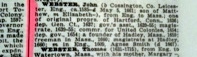
John Webster (1590-1661) is yet another of my 9th great grandfathers. Born in
Leicestershire, England, John arrived at Massachusetts Colony in the early 1630s, most sources seem to generally agree, with his wife Agnes Smith (1585-abt 1655) and their surviving children.

John was of the first settlers of Hartford in 1636, and served one term as governor of  Connecticut Colony. He is mentioned among the names of Hartford's founders here and is name is included on a founders' monument.

from Find a Grave
In addition to my 8th great grandfather Thomas Webster (1616-abt 1686), John's many descendants include my 6th cousin 4x removed, Noah Webster (1758-1843), the lexicographer who compiled dictionaries, including his first, A Compendious Dictionary of the English Language. This evolved into Webster's Dictionary, which is still updated and published today. Wordsmithing is an old family trait it seems.

Another of John's descendants, my 5th great grandfather Abraham Webster (1737-1812), migrated from Connecticut to Nova Scotia with my 5th great grandmother Margaret White (1732-1803) as a New England Planter in about 1760, and received a land grant in Cornwallis. My New England roots in Nova Scotia are deep, thanks to my several Planter ancestors.

The never ending story continues....


© Margaret Dougherty 2016-2017 All rights reserved

Saturday, 14 January 2017

Immigrant Ancestors -- Samuel Eddy (1608-1687)

My 10th great grandfather was Samuel Eddy (1608-1687) was born in Cranbrook, Kent, to a vicar, William Eddye and his wife Mary Fosten. He is yet another of my many ancestors listed in my favourite little book.

Samuel likely arrived in Plymouth Colony on 29 Oct 1630 with his older brother John, on the Handmaiden, which set sail from London on 10 Aug 1630 as part of the Great Migration. Some sources note that two of Samuel's sisters also migrated to New England.

Samuel was a tailor. He arrived in New England unmarried, but by 1636 had married Elizabeth Savory (abt 1607-1689), who had arrived from Wiltshire, England with her family in about 1633. Samuel and Elizabeth had at least four children who lived to adulthood, including my direct ancestor, their son, John Eddy (1637-1715). The Eddy family name joined with other immigrant families including my Daggett and Newcombe ancestors,

When I was a child, the Eddy Match Company was a well known Canadian company based in what was then called Hull, Quebec (now called Gatineau). I suspect that its founder, Ezra Butler Eddy, is one of my Eddy relatives.

More about Samuel Eddy's life and family is here. They and several other family members are buried in the Eddy Cemetery in Swansea, Massachusetts, which borders Rhode Island.

There are many Eddy descendants in North America today. In fact, there is an Eddy Family Association. Their website is something else for me to explore at some point -- it has lots of interesting items, to be sure.

The never ending story continues....


© Margaret Dougherty 2016-2017 All rights reserved

Saturday, 31 December 2016

Immigrant Ancestors -- Jane Gallion abt 1602-abt 1666

It is often said in genealogy research that finding information about our female ancestors is especially hard. It's as if women were non-persons when it came to record-keeping. You see vital and church records time and again where the male is listed but if the female is mentioned at all, it is by first name only.

Which brings me to my 9th great grandmother, Jane Gallion, who has fascinated me for reasons I can't explain since I first found her. The spelling of Jane's last name varies: Gallen, Gellyn, Gallin, Gellyn, Gallant, Gillon, and so on. Could she have been of French Huguenot origin? She may have been born in London (many references list that as her birthplace) in 1599, and baptized at the ancient church that still stands in the Strand, St Clement Danes, where the Gallin spelling is used. There is no record of the names of her parents.

Jane was married twice, first to Thomas Paine (abt 1608-abt 1635), described as a London merchant, who may have died either in England or in Massachusetts Colony. They had two children, Jane (abt 1625-1648 and Thomas (1632-abt 1657). Was Thomas Paine already in Massachusetts and did she join him? Or had they emigrated together as a family after the birth of their son? For a woman to undertake such a journey alone with two young children with no family to meet her would have been quite unusual at that time.

By 1635, Jane Gallion was married to Thomas Mayhew (1593-1682), and they had their first of four known daughters, Hannah (abt 1635-1723). It was a second marriage for both. I write about Thomas here -- my first immigrant ancestor profile. Their daughter, Martha (abt 1638-1717) is my 8th great grandmother.

Jane's daughter from her marriage to Thomas Paine, Jane Paine (abt 1625- abt 1648) went on to marry Thomas' son by his first marriage, Rev. Thomas Mayhew (abt 1616-1657).

While much is recorded about the life of Jane's husband Governor Thomas Mayhew, almost nothing can be found about Jane. I know that she is buried with her second husband Thomas Mayhew in Edgartown on Martha's Vineyard. Jane died about 1666, predeceasing her husband by about 22 years.

The never ending story continues.....


© Margaret Dougherty 2016 All rights reserved

Saturday, 17 December 2016

Immigrant Ancestors -- The Nutfield Connection

Heather Wilkinson Rojos writes a wonderful New England blog, Nutfield Genealogy, that covers the areas of Londonderry, Derry and and Windham in New Hampshire. Heather has become one of my genealogy blogger heroes for her well-researched and informative posts.

Nutfield was the name of the original land grant given to the first Scots Irish settlers in 1719. As Heather explains in her FAQs

Londonderry is where my early Scots-Irish ancestors first settled after arriving from Ulster. When I say early, I'm speaking of mid 18th century. My Moore or Moor, Morrison and Logan ancestors who later settled in Nova Scotia were first in New Hampshire.

I'm sharing two of Heather's recent posts that are both keepers for me: How did the Scots Irish celebrate Christmas? and Top ten books about Nutfield history and genealogy.

And because there is always more research to do, the never ending story continues.....


© Margaret Dougherty 2016 All rights reserved

Saturday, 10 December 2016

Immigrant Ancestor: Abraham Pierce

Another 9th great grandfather of mine, Abraham Pierce (abt 1605-abt 1673), arrived at Plymouth Colony in July 1623 from England on the Anne, along with several other ancestors. Plimoth Plantation has this information about Grandpa Abe. Apparently, he was about 18 years old when he arrived, possibly as a servant to another passenger. This is mentioned in several sources. He was the first Pierce to settle in the Americas.

FamilySearch.org has this more interesting biographical sketch, sourced to The Great Migration Begins: Immigration to New England 1620-1633. Abraham's origins in England are unknown.

He married by about 1637 to a woman named Rebecca. Together, they had five children, the youngest of whom is my 8th great grandmother, Alice Pierce (abt 1650 - 1712). He was a freeman of Plymouth, and by about 1642 had settled in Duxbury in Plymouth Colony.

Abraham may have been an original purchaser of Bridgewater, adjacent to Duxbury in about 1645, but never lived there, according to some sources. He died in Duxbury by June 1673. Like many early settlers of the Americas, too little is known about him and his family. Their stories are lost to history.

The never ending story continues....

Saturday, 22 October 2016

Immigrant Ancestors: Thomas Birchard (1595-1657)

My 9th great grandfather, Thomas Birchard, was born in 1595 in Essex, England. Setting sail in September 1635, he arrived at Boston on the Truelove with his wife, Mary Robinson (1597-1655) and six children, including my 8th great grandfather, John Birchard (abt 1628-1702), who was then just seven years old. On the ship manifest, Thomas is described as a labouring man. They came as part of the Great Migration.

Thomas is another of my growing number of ancestors listed in my favourite handy little resource. He was most likely a Puritan.

Thomas and his family spent their first few years in New England in Roxbury, which was annexed to Boston in 1868. It was one of the first few towns of the Massachusetts Bay Colony, settled in 1630.

By 1639, the Birchards were in Hartford, Connecticut. Thomas is recognized as one of that city's founders, having settled there before February 1640.

By 1653, the Birchards were living in Edgartown, on Martha's Vineyard, where he became town clerk. In those days, the journey between Hartford and Martha's Vineyard would not have been a straightforward affair. I wonder what prompted Thomas to leave Hartford and to settle on Martha's Vineyard as his family's new home. Was his son, John, already there?

In about 1655, Thomas' wife Mary died. Some sources say this happened in Roxbury, but we know that by 1653, Thomas was on Martha's Vineyard. In any case, Thomas remarried at least once more in Edgartown, and possibly twice.

Now, Martha's Vineyard was the domain of my ancestor Governor Thomas Mayhew, another of my 9th great grandfathers. I wrote about him here. In 1673, a movement began to oust Mayhew, and Thomas was apparently the first to sign a petition to the General Court at Massachusetts Bay. The movement was crushed.

By 1682, Thomas had relocated yet again, to Norwich, Connecticut, where John was then living as one of that town's first proprietors. Thomas died in Norwich

A manuscript published in 1927 claims to have traced the first Birchard all the way back to the Franks in 496. I might take that with a grain of salt.

The never ending story continues....

Saturday, 15 October 2016

Immigrant Ancestors: Hugh Moore (1738-1820)

My 4th great grandfather on my father's side was Hugh Moore (1738-1820), who, with his four or five siblings and his widowed mother, was among the New England Planters who were grantees in Nova Scotia. Hugh and his family arrived in the Truro area in 1760, and received a land grant there 31 Oct 1765.

Hugh was born to Hugh Moore (abt 1708-bef 1758) and Janet Morrison (abt 1705-aft1760) in about 1738).  It's not clear whether Hugh #4 GGF was born in Ireland or in New England. His father Hugh died in New Hampshire before 1758.

My #4GGF Hugh's parents had emigrated to New England from Ireland, and were among a large group of similar Ulster Scots who settled in the community of Londonderry, New Hampshire before 1744, or perhaps as early as before 1738, which is about when Hugh was born.

Both Hugh #4GGF and his father Hugh #3 both married women named Janet. That's right. Hugh Moore married Janet Logan (abt 1746-1818 in Londonderry, New Hampshire, shortly before they and the rest of the Moores made the journey to Nova Scotia as New England Planters. All of Hugh #4GGF and Janet Logan's eight children were Nova Scotia-born.

I'll be honest. Because both sets of these ancestors were named Hugh and Janet, I've made many errors through my years of research. Whenever I found a new error, I would have to go back and double check my complete research for this family. Aggravating? Why yes, it was and often continues to be.

This story in particular needs yet more research.

The never ending story continues....

Saturday, 8 October 2016

Our immigrant ancestors -- Thomas Butler (1781-aft 1819)

Much of my 3rd great grandfather Thomas Butler's life after his marriage on 7 Apr 1806 in Massachusetts to Mary Southwick (1788-1865) remains a mystery to this day. He wasn't considered part of the New England planter migration and settlement in Nova Scotia -- that era had passed by the time he migrated to Nova Scotia.

Massachusetts Vital Records
Thomas was born on 20 May 1781 in Falmouth on Cape Cod to Captain John Butler (1751-1794) and Parnel (or Pernal) Hatch (abt 1759-1842). He was the eldest of six children.

There is an unproven story passed down that Captain John served in the British Navy and was lost at sea.

At some point after their 1806 marriage, Thomas and Mary arrived in Nova Scotia, initially in Halifax. Was this Thomas a sailor?

Thomas and Mary had perhaps four sons. It's not known whether the two eldest were born in Massachusetts or Nova Scotia. However the marriage certificate of their third son, my 2nd great grandfather Samuel (1816-1887) to his second wife, Esther Lawson, notes that he was born in Halifax.

Thomas may have died around 1819, but documentation for that is difficult to find. His widow Mary remained in Upper Stewiacke, no doubt to be near her son and grandchildren, until she died in 1865.

I've traced Thomas' ancestry back five generations, to another Thomas Butler (abt 1617-abt 1689), who was born in England, and arrived in New England in about 1637, settling in Sandwich on Cape Cod. We don't know where in England that first Thomas was born.

There is another old Butler family in Massachusetts, this one on Martha's Vineyard, where the first recorded there was a Nicholas Butler (abt 1588-1671). There is no proven link between Nicholas of Martha's Vineyard and Thomas of Cape Cod, but perhaps Nicholas was a nephew? One of  Nicholas' Martha's Vineyard descendants -- yet another Thomas Butler (1654-1732) -- married a 1st cousins 9x removed of mine, Jemima Daggett (abt 1666-?), granddaughter of Governor Thomas Mayhew, who was the second immigrant ancestor that I profiled here.

There are many unsolved mysteries with this immigrant ancestor. Hopefully, there are records yet to be found in both Cape Cod and Nova Scotia that will explain all....eventually.

The never ending story continues....

Saturday, 1 October 2016

Our immigrant ancestors -- Hugh Calkins (abt 1603-1690)

Immigrant Ancestors listing
My 9th great grandfather Hugh Calkins arrived with his family in New England in 1638 as part of the Welsh Company, a group led by a minister, which sailed from Wales, but whose members may not all have been Welsh, seeking religious freedom. The minister may or may not have been ejected from his position in Britain, which may have been the catalyst for him leading a group of about 50 families to New England.


Hugh is one of dozens of my immigrant ancestors listed in my favourite little reference book. As noted there, Hugh was one of the founders of Gloucester, Massachusetts. He and his wife Ann (last name unknown) had at least nine children, the youngest of whom were born in New England. Through his children, he has many descendants across North America today.

William Cutter writes in his 1910 book, Genealogical and Personal Memoirs Relating to the Families of the State of Massachusetts, "Hugh Calkins was a radical, in religion a non-conformist, and living in the troublous times of Charles, the First, soon became satisfied that there were safer countries than England and Wales—for men who wished to worship God according to the dictates of their own consciences. Accordingly, he with his wife, Ann, and John, their son, then four years old, joined a body of emigrants called the 'Welch Company,' and with their pastor, Rev. Richard Blinman, embarked and came to America, about 1638 or 1640.” Does this mean he was a Puritan? I don't know. 

Hugh was born in Cheshire, the English county that borders on Wales, and was christened on 3 Apr 1603 in Waverton, Cheshire, England. We know from his christening record that his father's name was Rowland. 

His son, my 8th great grandfather John Calkins (1634-1703), was one of the founders of Norwich, Connecticut in 1659. His name, together with the other town founders, is listed on a monument in Founders Cemetery there.


At some point, the "s" was dropped in the family name. Hugh's great grandson (and my 6th great grandfather), Jeremiah Calkin (1705-aft 1770) migrated from New England to Nova Scotia as a New England Planter as a widower, with his family in about 1760. Jeremiah had been married to Rachel Janes (1700-bef 1760) in Connecticut in 1725, and they had at least five children.

Jeremiah's house still stands today in Kings, Nova Scotia. Jeremiah's daughter (and my 5th great grandmother), Lucy, migrated to Nova Scotia separately with her husband Jonathan Godfrey, as I noted here.

The more you research, the more you know. Early on, I was thrilled to discover Hugh Calkins because, based on what I initially read, I thought that I had Welsh ancestry. Sigh. But the more I researched I learned that he was an Englishman.

The never ending story continues....

Saturday, 17 September 2016

Our immigrant ancestors -- David Godfrey & Priscilla Baker

Continuing to recount my New England ancestors, my 6th great grandparents, David Godfrey (abt 1707-abt 1777) and Priscilla Baker (abt 1710-abt 1777) married on Cape Cod in Chatham on 14 Oct 1731. Through his grandmother Deborah Cooke, David is a 2nd great grandson of Mayflower passengers Stephen Hopkins, and great grandson of Giles Hopkins.

By about 1748, David and Priscilla had moved with their family to Connecticut, where they lived for about 12 or 13 years. They followed their eldest son, a sea captain, also David (1732-1813), to Nova Scotia, as part of the New England Planters' arrival in about 1761, when David received a land grant in Horton, which he farmed. David and Priscilla remained in Nova Scotia for the rest of their lives.

I descend from David and Priscilla's second son, Jonathan (1739-1826) and his wife, Lucy Calkin (1740-1825), who after arriving from Connecticut, lived first in Cornwallis and later, Windsor. They arrived in Nova Scotia about 1766.

There are many Godfrey descendants across North America today, including of course, in Nova Scotia.

The earliest Godfreys are recorded in Eastham, on Cape Cod in the mid 1660s. The first, George Godfrey, arrived there by 1661 from England, married (his wife's name is unknown), and began a family that grew to at least nine children, born between 1663 and 1688.

The never ending story continues...

Saturday, 3 September 2016

Our immigrant ancestors -- Samuel A. Fisher (1758-1812)

My 4th paternal great grandfather was Samuel A. Fisher, who was born in Londonderry, New Hampshire in 1758 to Deacon Samuel Fisher and Sarah Barber. In chapter 38 of his 1873 book, Historical and Genealogical Record of the First Settlers of Colchester County, Thomas Miller writes this about of Samuel A.:
"Samuel, son of Deacon Samuel Fisher, was born in Londonderry, New Hampshire.  He removed to Nova Scotia in 1767.  He was married to Mary, daughter of Eliakim Tupper, Esq., and Elizabeth Newcomb.  He settled on the interval farm that is now owned by Mr. Samuel Butler and Mr. Patterson, on the south side of the Stewiacke River, in 1784.  He was a worthy man; he went by the name of Deacon Fisher also.  He died in Stewiacke, May 12th, 1812."
Miller also writes about the passage of Samuel's father, Deacon Samuel Fisher, my 5th great grandfather from Ireland to America this:
"Deacon Samuel Fisher was born in the North of Ireland, in the year 1722, and was of Scottish descent. His father was a weaver. He came to America in 1740, in the 19th year of his age. The ship in which he came was usually spoken of as "The starved ship". The vessel was so scantily supplied with provisions, that, long before the voyage was completed, one pint of oatmeal for each individual on board, and a proportionate allowance of water, was all that remained. Mr. Fisher once went to the mate with a tablespoon to obtain some water, which was refused him, there being but two-thirds of a bottlefull on board. Mr. Fisher's custom was to take a spoonfull of meal and having moistened it with salt water, to eat it raw. The passengers and crew, having subsisted in this manner for fourteen days, were at length reduced to the necessity of eating the bodies of those who died. Even this resource failed them; and, at length, Mr. Fisher was selected to give up his life to preserve the lives of the rest. Providentially, however, a vessel hove in sight; and their signals of distress being observed, they obtained relief, and he was saved. So deep an impression did the horrors of that passage make upon the mind of Mr. Fisher, that, in after life, he could never see, without pain, the least morsel of food wasted, or a pail of water thrown on the ground carelessly."
What a harrowing journey! This story takes my breath away. Deacon Samuel married three times in New Hampshire. Samuel A. is the second son of his final marriage, to Sarah Barber, my 5th great grandmother.

Samuel A. arrived in Truro, Colchester, Nova Scotia in about 1767, aged nine, with his older half sister, Janet and her husband Matthew Archibald. He married Mary Tupper (1766-1812), a daughter of Eliakim Tupper and Elizabeth Newcomb in about 1786, and they went on to have ten children, making their home in Upper Stewiake, Colchester, Nova Scotia, where he farmed. In 1791, Samuel A. is recorded in a poll tax roll as residing there.

Samuel A. died on 12 May 1812, following Mary, who predeceased him only weeks earlier on 23 Apr 1812. It is reported in sources that Samuel A. and Mary were the first white people to be buried in Upper Stewiake's Riverside Cemetery, built on land that had originally been an Aboriginal burying ground.

The never ending story continues...

Saturday, 20 August 2016

Our Immigrant Ancestors -- the Kingston, New York Doughertys

Despite the name of the county in which it is located, Kingston was originally settled by the Dutch. Later, there was an influx of German immigrants, and then in the mid 19th century, the Irish began to arrive, including six of my 1st cousins 3x removed, five of whom remained in Kingston or New York City. Today, Kingston is about an hour north of Manhattan.

Only one of their spouses was born with certainty in New York. I wonder if my other cousins' spouses were born in or near Dungiven.

Rev James Dougherty
Michael (abt 1810-1853) m Ann O'Reilly (abt 1816-1852). I haven't found a record of their marriage either in Ireland or New York so far. They were in Rondout/Kingston by 1843, when the first of their four children were born, but they both had died by the time their eldest was ten years old. Their children:
  • James (1843-1906) ordained as a priest
  • Mary Anne (1845-1933) m David P. Hallahan, 1 daughter
  • Isabella (1848-1924) took vows as an Ursuline nun (Mother Ambrose)
  • Elizabeth (abt 1851-1931) never married
Isabella Dougherty McReynolds 
Isabella (abt 1813-1897) m Bernard MacReynolds, childless. From Bernard's marker, we know that he was born in Dungiven.

Margaret (abt 1819-1893) m  James McGranahan, who was born in Rosenale, Ulster, New York. They were in Rondout/Kingston by about 1850 when their first child was born:
  • Anna (abt 1850-?)
  • Margaret (1852-1931) never married
  • Isabella (abt 1855-?)
  • William J. (abt 1857-1892) became a lawyer, never married
  • Margaret & James McGranahan
  • Rosemary (1864-1940) m James W. Allen
Mary O'Reilly
Mary (1820-1908) m Andrew O'Reilly (possibly a sibling of Ann O'Reilly). Here again, there is no record of their marriage in either New York or Ireland. They had nine children, all of whom were born in Kingston:
  • John C. (1839-1906) an ordained priest
  • Andrew B. (1842-1872) never married
  • Terrence J. (abt 1845-1886) never married
  • Mary Theresa (abt 1847-aft 1880)
  • Margaret (abt 1847-?)
  • Joseph A. (abt 1850-aft 1880)
  • Thomas (1851-1855)
  • James Augustine (1854-1855)
  • Roseanna (1859-1938) married and had three children
Mary, Andrew and three of their children are listed on a monument in St Mary's Cemetery in Kingston. It's not clear what happened to Joseph, Margaret and Mary Theresa. 

Bridget Dougherty Hayden
Obituary 
Bridget (abt 1821-1916) m. William B. Hayden, I believe in New York. I have found an immigration record noting that Bridget arrived in 1849. Bridget and William had five children:
  • Thomas (1853-1855)
  • Mary M. (1856-1921) m James W. Allen, childless 
  • Isabella (1858-1941) never married 
  • Helen E. (1862-1940) m1 John Fitzgerald; m2 John Kearney, no children
  • William J. (1865-1926) m Anna Sweeney, eight children
Thomas (abt 1823-1854) appears in the 1850 census in Kingston, living with his brother Michael and his family, but soon returned to Ireland. He died, unmarried in 1854 in Dunvigen.

Isabella, Margaret and Bridget each outlived their husbands, and all died in New York City. Bridget's children all settled in and around Jersey City, New Jersey. 

I did make an interesting discovery in researching these families. Mary E. Hayden married James W. Allen in New York City. After her 1921 death, James then married Mary's cousin Rosemary McGranahan. Both marriages were childless. Rosemary survived James. 

There were other Doughertys in Kingston as well, census and other records reveal. Were these relatives? As I've asked before, why did my cousins choose Kingston over Vermont or Cincinnati or Granby? Once one arrived there, the rest seem to have followed. As I noted here, Fr James officiated at several baptisms, marriages and funerals of his uncle Judge Marcus' family. Bridget Dougherty Hayden's obituary notes that she was sister to Judge Marcus. 

There were family ties. But did the Kingston Doughertys stay in touch at all with the Cincinnati Doughertys or my 2nd great grandfather (farmer) Marcus? When were those family ties lost? 

The never ending story continues...

Saturday, 13 August 2016

Our immigrant ancestors -- Judge Marcus Doherty QC

Judge Marcus Doherty
My 1st cousin 3x removed, Marcus Doherty (1815-1903) emigrated from Camnish, Dunvigen in what is now County Derry at the age of 18, arriving in Quebec City in 1833, and then travelling down to South Hero, Vermont, to join his uncles (my 2nd great grandfather) Marcus and (my 2nd great great uncle) James Dougherty.

Marcus was born in a house in Camnish, Dungiven, that was later occupied by the family of Irish nationalist John Mitchel.

The story is that Marcus was sent to Vermont by his mother after his father Thomas Dougherty died in Dungiven. He wasn't their eldest, but I think he was the brightest, and had attended grammar school in Dungiven, something one of my internet cousins tells me was quite rare for an Irish person to do in the early 19th century. One story has it that he was destined for the priesthood. Marcus attended college and also  taught at the Shefford Academy, where his uncle James was the principal. In 1838, he enrolled at  the University of Vermont where he received his BA and MA, and in 1848 was called to the Bar of Lower Canada in Montreal. He was appointed to the Quebec Superior Court in 1873. I've found many references in which Judge Marcus is mentioned. He first practised law as a newly minted lawyer in Granby, then moved on to Montreal. He was then posted in Sherbrooke for several years, before returning to Montreal.

Judge Marcus' eldest children were born and baptized in Granby. In my very early web research days, and before the Drouin Collection had indexed the Notre Dame de Granby parish records, another researcher, in an act of random genealogical kindness, pointed out to me that having a Marcus Dougherty and Marcus Doherty in the same small community at the same time was, well, no coincidence. My great grandfather John James and Judge Marcus were cousins.

In my family papers, we have for reasons still unknown to me, a copy the certificate attesting Judge Marcus' entry into the Bar of Lower Canada. The seal has been cut out. How did this come to be in my grandfather's possession?

Marcus was the first of six siblings to leave their Camnish, Dungiven home for America. Those siblings who came all used the Dougherty spelling. More about those siblings and their families will come. No, I don't know why Judge Marcus used the Doherty spelling. His siblings who remained in Ireland used both Dougherty and Doherty. Yes, all these same names do get confusing in the telling of stories.

Full disclosure: In 1998 and 1999, a woman posted on several genealogy message boards seeking relatives of Judge Marcus, and saying he was the brother of her late husband's great great grandfather. She even contacted me, saying we were related. But this was in my dark age of the genealogy research, and I brushed her off. Of course, it turned out she was absolutely right, but by then several years had passed, and I was unable to locate her. It was an early lesson to never make assumptions.

Montreal - Biographical Sketches
An early biography of Judge Marcus appeared during his lifetime in something called Montreal - Biographical Sketches. Note the inconsistencies about his year of birth and John Mitchel.

Here's another profile (in two images), from the Canadian Biographical Dictionary:


Note the inconsistencies in both with respect to Judge Marcus' year of birth and John Mitchel. It wasn't always easy in the mid 19th century to fact check, I guess. No Google, for one thing.

Judge Marcus died in Montreal on 4 Jul 1903. The Montreal Gazette carried a lengthy obituary about him and his remarkable career, which offers yet more conflicting information on his year of birth and other facts.

I will be writing more about Judge Marcus, his marriage and family. Note: For identification purposes in this blog, this Marcus will be called Judge Marcus, while my 2nd great grandfather will be referred to as Farmer Marcus. My small contribution to ending the confusion over the use of the same names even within the same generations.

The never ending story continues...

Saturday, 6 August 2016

Our Immigrant Ancestors -- the New England Planters of Nova Scotia

In addition to my 4th great grandfather Alexander Nelson, all of my Nova Scotia roots come from England, Scotland, Wales and Ireland, via New England, more specifically Massachusetts, New Hampshire and Connecticut. 

The first of my ancestors to reach Nova Scotia following Alexander Nelson were also part of the 2,000 families who were New England Planters, arriving between 1759 and 1768, after the Acadian Expulsion. I have New England Planter ancestors who settled in Colchester County and the Annapolis Valley. They were primarily farmers and fishers when they arrived.

These direct ancestors had family names such as Fisher, Forbes, Godfrey, McClane/McLean, Moor, Newcomb, Tupper and Webster. These are names still found in Nova Scotia, more than 200 years later. 

Planters is an Elizabethan English term for settlers. After the Acadian Expulsion by the British, notices were published in New England newspapers offering free land to anyone who would go to Nova Scotia to farm land formerly occupied by Acadians.  

Sir Charles Tupper
Canada's seventh prime minister, Sir Charles Tupper, who holds the record for serving the shortest term as prime minister--10 weeks--(there's a good trivia question), led Nova Scotia into Confederation and is one of Canada's Fathers of Confederation, is the descendant of New England Planters. Oh, and he's also my 3rd cousin 5x removed--not necessarily a great trivia question. 

Want to know more about the New England Planters? 
The never ending story continues...

Saturday, 30 July 2016

Our immigrant ancestors -- Governor Thomas Mayhew

A few years ago, a wonderful fellow Mayflower descendant clued me into an incredible little book originally published in 1942 that lists alphabetically, with very brief biographical sketches, the names of 2,500 of the earliest immigrants to America. I periodically go through Immigrant Ancestors: a list of 2500 immigrants to America before 1750 when on one of my all too often research binges, and at last count, I have 26 direct ancestors listed in it.

Yes, these are immigrants to America, but as I've noted, I have many ancestral links to New England, including Cape Cod, Martha's Vineyard, Connecticut and New Hampshire. In fact, at one point very early on, one of my ancestors, Governor Thomas Mayhew (1593-1682), held the land titles to Martha's Vineyard and Nantucket. He received the original land grants in the 1640s.

Thomas is my 9th great grandfather. He arrived at Plymouth Colony as part of the Great Migration of Puritans in 1631/32 from the Southampton area, where he was a merchant. He was born in Wiltshire. Read what is said about him in Immigrant Ancestors (l). Yes, there's a discrepancy in the dates given in that 1942 publication, but as more and more confirmed, sourced documentation has come to light, this is common.

The never ending story continues....

About the Family of Robert Young and Isabella Knox

I wrote about my great grandfather, Robert Alexander Young , here . Now it's time to write about the family he and my great grandmother...