Friday, 3 July 2020

About the Family of Robert Young and Isabella Knox

I wrote about my great grandfather, Robert Alexander Young, here. Now it's time to write about the family he and my great grandmother, Isabella Knox, had. Robert and Isabella married in Berwick upon Tweed in 1884. They had ten children:

  • Margaret Knox 1885-1950
  • Elizabeth 1888-1890
  • Dorothy 1889-1967
  • Henry (Harry) 1891-1979
  • Robert 1893-1964
  • Isabella (Izzy) 1897-
  • Elizabeth (Lizzie) 1899-1986
  • William John (Willie) 1901-1977
  • Peter 1904-
  • Agnes 1905-

Censuses from 1891 to 1911 document that Robert, Isabella and their lived in different houses throughout their marriage, but most often in houses in the Greenses, as his parents and grandparents did, and where in fact generations of Youngs lived in the 19th and 20th centuries. Perhaps even in the 17th century. I am in awe of knowing that my ancestors lived in one place for centuries.

The Greens - Low Greens and High Greenses - about 1897
I wrote here about the Berwick house where my mother was born in 1919 -- not in the Greenses.

My grandmother, Dorothy, made her life in Canada, along with her sister Lizzie, who married and lived in Montreal. Their sisters Izzy and Aggie would visit Montreal and return to Berwick, more than once through the years. I remember my mother speaking with them on the phone, but never met them. Their brothers and sister all stayed in Berwick or elsewhere in northern England, to the best I've been able to discover. I'm still researching some of them.

Recently, I've connected with the grandchildren of my grandmother's oldest sister, Margaret. One grand daughter shares my mother's smile, which my niece, her grand daughter shares. That's magical.

The never ending story continues ....


© Margaret Dougherty 2016-2020  All rights reserved

Sunday, 21 June 2020

A father's final letter to a son


page 1
I've been sorting through several bins of decades worth of photographs, letters and other mementos collected by my parents and grandparents. It's a massive and very long overdue task, and I admit that it's slow going.

One reason this project is slow going is because of the many discoveries that I'm making. And in many cases, I stop the work and get lost in thought, pondering over photos or letters, like this letter that surfaced this week.

The letter is from my great grandfather to his son, my grandfather, and is written from a hospital, undated, except for the year: 1908. My great grandfather would then have been 74 years old. I don't know what town the hospital was, only that it is where my grandfather's "Aunt Maggie lives."  This was probably my great aunt, Margaret Grace Darling Ross Gillies.

page 2
My great grandfather, Frank Gillanders Matheson, was recovering from an operation that left him a shadow of his former self, he wrote. What was that operation for, I wonder? He could no longer work, and said he had to leave the house where he and Annie, my great grandmother, lived. Their 28 year old blind and mentally challenged son, Alex would certainly have been with them, and possibly their daughter Annie, with her infant son, Andrew. The rest of their surviving children were living elsewhere, in service or apprenticed.

As can be seen here, Frank's faith played a large part in his life. He possessed a three-volume bible, in fact, that I wrote about here and as I noted in my last post, was a deacon at his local church. He was a devout Presbyterian. 

Frank's comments about his loneliness in hospital and about some of the people in his life give a brief insight into 1908 life in the Scottish Highlands. Is it odd that he doesn't mention his wife? I don't know.

page 3
I don't think that in the end, Frank and Annie had to move, as his death registration notes that he died at the Railway Cottages at Delfaber, Duthil. But such a great worry that must have been.

My grandfather, John, emigrated from Scotland to Montreal in June 1907. I know he didn't get to see his father, Frank Gillanders Matheson again, as Frank died in June 1909. That he kept this 1908 letter from his father the rest of his life speaks volumes, doesn't it?

The never ending story continues....


page 4

© Margaret Dougherty 2016-2020 All rights reserved

Saturday, 20 June 2020

When Letters of Introduction were always a good idea


I wrote here about when my grandfather, John Matheson, left Scotland for Montreal on June 8, 1908. That was still a time when a letter of introduction from your church minister could often open doors when you searched for work or a roof over your head in a strange new place. In what has become an epic task, I've been slowly sorting through memory bins as I call them .... the bins of accumulated family records and documents. The finds are always rewarding. I recall many from years ago, when I did a purge, but now that so much of my life is immersed in all things genealogy, they of course have new meaning.


Here is a June 7, 1908 letter of introduction from A.M. MacLeod, Minister of the United Free Church of Scotland, written from the United Free Church Manse at Rothiemurchus, Avimore, as noted on the embossed letter.

Imagine in the whirl of packing and farewells, before you sailed the very next day to Canada, stopping at the Manse to get this letter of introduction.

I like that Rev MacLeod notes that while my grandfather wasn't a "member of the church, he has regularly attended its services and has been a devout and intelligent listener."


But the kicker is Rev MacLeod's closing sentence on page 2. Surely mentioning that the bearer's father is a church deacon and that he is "one of the most respected men in the district." was enough to ensure whatever doors needed opening for my grandfather in Montreal were opened. 

Perhaps it was my great grandfather Frank who secured this excellent letter of introduction on his son's behalf. 


The never ending story continues ....


© Margaret Dougherty 2016-2020 All rights reserved

Wednesday, 22 January 2020

When Andrew Horne left Scotland to live in Montreal

I first mention Andrew Horne, who was my first cousin once removed on my mum's side when I wrote about his father here. I later wrote about his mother, my great aunt, who died in 1918 in the Spanish Flu epidemic here.

Andrew was just 10 years old when his mum died. He continued living with his step-father, a career soldier, in hard scrabble Gourock, just north west of Glasgow. But Andrew was ill-treated by his step-father. When word of this reached his Matheson aunt and granny he was taken from Gourock and went to live in Nethy Bridge with his granny, my great grandmother, Annie Ross Matheson.

After his granny died just before Christmas in 1922, Andrew was sent to the Quarriers Orphans Home at Bridge of Weir, but only several months. Here it gets a little confusing, but I think I've sorted out what happened. I had known from my mum and aunt that Andrew came to Montreal as a teenager, to live with his uncle Frank and his family. He was closer in age to Frank, who was born in 1892, than to my grandfather, his uncle John, who was born in 1884.

Declaration of Passenger to Canada
Researching Andrew's departure for Canada a few years ago, I found the information card on the right, confirming his departure from Glasgow on 23 Aug 1923 on the Athenia -- note that he was going to Canada to settle with his uncle.

A couple of years ago, another DNA cousin sent me information about Quarriers Homes at Bridge of Weir, saying that Andrew had lived there before coming to Canada.

Out of curiousity, I checked Library and Archives' British Home Child collection. There, I found contradictory information, indicating that Andrew was a passenger on the Cassandra, which arrived in Canada in April 1923. The record notes he was destined for Brockville, Ontario. Quarriers had afacility in Brockville where all newly arrived boys were first sent before being sent on to other places.

Library and Archives Canada
British Home Child Collection


I kept researching. On the British Home Children Advocacy & Research Association website, I found the photograph below of boys, the caption of which went so far as to list Andrew, and said the photo was on t the caption identifying him on a photograph purportedly taken onboard the Cassandra.


from British Home Children Advocacy & Research Association website

But I still couldn't find any record of Andrew leaving Scotland in late March or early April 1923 on the Cassandra, or any other ship.

Next, I contacted Quarriers Home at Bridge of Weir, and they confirmed to me that the August date is the correct date Andrew left Scotland.

What happened? Remember, Andrew's granny died at Christmas 1922. Was he sent immediately to Quarriers? Or early in 1923? I think there were too many children at Bridge of Weir, and I have a theory about what probably happened. His aunt Kitty was already the legal guardian of her handicapped brother, Alex, whom I wrote about here. Kitty was from my great grandfather's first marriage, and in 1923 she was 54 years old. But Kitty wasn't for whatever reason able to take on raising a 15 year old, when she herself was childless and her husband was a Glasgow police detective.

Aside from Kitty and Alex, my grandfather and great uncle were the only family members Andrew had left. I wonder if Quarriers moved that quickly to organize for Andrew to be sent to Canada, that when his interim guardian, his aunt Kitty, found out, she leapt into action and contacted her brothers in Montreal. It seems to me that it was a very lucky break for Andrew that he was pulled off the April 1923 manifest. But not soon enough for a photograph to be taken -- not on the Cassandra or on arrival in Brockville.


Quarriers have a small amount of records about Andrew's time there, but wanted 60 GBP to copy and send these to me. As this is over $100 Canadian for me, I decided against getting his records.

Andrew was embraced by his uncles and their families when he reached Montreal. Until then, he certainly hadn't had a lot of stability, and indeed had experienced trauma as a child. My sense is that he always wanted to belong. Just belong.

Andrew served overseas in the Canadian Army in the Second World War, married afterwards, but was childless. I met him a few times. Andrew was a very kind, gentle, and soft spoken man. He wrote me letters addressed "Dear cousin Margie".


The never ending story continues....


© Margaret Dougherty 2016-2020 All rights reserved

Monday, 6 January 2020

On this day 201 years ago: Sarah Anne Moore was born

If you have your tree on FamilySearch, you can get email notifications about the birthdays of your ancestors. And so today, I was reminded, is the birthday of my 2nd great grandmother, Sarah Anne Moore.

It is through Sarah that I descend from Hugh Moore, my 4th great grandfather, who with several other family members, came to Nova Scotia from New Hampshire as New England Planters and were among the first grantees in Colchester in 1760. Their origins were Ulster Scots. The Moores were a very large family, and they in turn had their own very large families, and so on, and so forth.

Sarah was one of at least six children, possibly the youngest, born to Robert Moore (1770-1852) and Margaret O'Brien (abt 1775-1862), whose origins were also Ulster Scots.

Sarah married Charles Nelson, a farmer, in 1845. We know of only two children: Elias, my great grandfather, and the infamous Horatio, whom I wrote about here. There are no records to tell us if they had other children who died young. Census records from 1871 and 1881 tell us she was Presbyterian. Charles identified as Free Church.

Sarah died in 1889. We don't know when in 1889, as that fell between 1878 and 1907, a black hole at Nova Scotia Historical Vital Statistics for which death information is not available. 

She and Charles, who died in 1892, are buried in the Nelson family plot at Watson Cemetery in Truro.

Happy birthday, granny Sarah. Thinking of you.

The never ending story continues....


© Margaret Dougherty 2016-2020 All rights reserved

Sunday, 24 November 2019

Why Katie Fraser McKeigan went from Canada to Kentucky

My first cousin 3x removed was Edinburgh-born Margaret Falconer, about whom I wrote here. She was the eldest daughter of my 2nd great grand-aunt, Ann Smith. While drilling down into the lines of Margaret's children from time to time this year, I came across records and an obituary for Catherine Elizabeth Fraser (1869-1932), her eldest daughter by her second husband, John Fraser, in Louisville, Kentucky. Catherine, or Katie, was also born in Edinburgh, travelling to Manitoba in 1882 with her family.

Wait! What? Now, here was a mystery. How did Katie end up in Kentucky, living at the same address as one W. H. McKeigan, and who was that? Through statutory and newspaper records, learned her story.


Nanaimo Daily News 9 Apr 1895
Catherine (or Katie) married a Nova Scotia man, Daniel McKeigan, in New Westminster, British Columbia on 29 May 1892, when she was 23. She had gone from Manitoba to British Columbia, apparently on her own, leaving her family. I haven't found Catherine on the 1891 Canada census, but her marriage registration notes that her residence at the time of her marriage was still Brandon, Manitoba, where her family then lived. As we know, people were often overlooked in censuses in those days.

Daniel was born on Cape Breton in Nova Scotia and was a miner. Cape Breton is where many Scots who came to Canada settled in the 19th century. He was a miner, working near Nanaimo, on Vancouver Island. How and where Dan and Katie met is a mystery. New Westminster is on the mainland. Nanaimo, where they made their home, then was reached only by ship or ferry.

Katie and Dan quickly had their first child, John Falconer McKeigan, in 1893, and Katie was pregnant again when disaster struck in April 1895. Dan was killed instantly by falling rock in the mine shaft where he was working. The story at the right goes on at some length describing the incident and recovery efforts.

Katie stayed on in Nanaimo after Dan's death, and gave birth to their second son a few months later.  I didn't find Katie and her sons again until the 1916 Prairies census, when they were living in Winnipeg, where Katie ran a boarding house. Katie's eldest son, John, died in 1920 there in 1920. She and William are still in Winnipeg when the 1921 census was done.

But then I found Katie in the 1930 US census in Louisville, Kentucky, and according to that census she arrived there in 1924. She was by then working as a housekeeper at a boys' home. I then found her listed in a few Louisville city directories through the 1920s, which is how I learned that she had gone there from Winnipeg with her son William in 1924.

I was at loss to understand why Katie and William went to Louisville, until I found Katie's 1932 obituary, above. Besides her son, Katie was survived by a brother, Rev J. F. Fraser, formerly of Louisville and then of New York.

Yes, it was one of those lovely a-ha moments we so love in genealogy. J. F. Fraser was Katie's younger brother, John Falconer Fraser, whom I hadn't yet begun to research.

There will be more to come about the Reverend Fraser.

And what of Katie's son, William? He made his home in Louisville, dying there in 1964. I learned more about his life from his obituary, seen below.

Back to Katie's mum, Margaret Falconer Fraser. I'm getting closer to finding out when Margaret and her husband, John Fraser, died, having found them in the 1906 census of the prairie provinces, living in Nanton, Alberta, a farming community, with their youngest son, James D. Fraser (Aside: Alberta statutory records are really the most awful to research).


Louisville Courier-Journal, 4 Feb 1964

The never ending story continues ....


© Margaret Dougherty 2016-2019 All rights reserved

Thursday, 14 November 2019

From Scotland to Quebec: Alexander Dalziel & Rachel Cook

Alexander Dalziel (pronounced Dee-yall) is the second of three Scots ancestors of my Québécois sister-in-law, nephew and niece, who settled in Quebec. From Alex's 1812 burial record when he was said to have been about 51 years old, we can ballpark his birth as about 1761. Alex was born in Scotland, but we don't know where, and we have no confirmed information about his parents. We don't know what circumstances drew him to Quebec, but he was there by 1790.

On 25 May 1790, Alexander married another Scot, Rachel Cook, at St Andrew's Presbyterian Church in Quebec City. The church still stands today, and is the oldest English-speaking congregation of Scots origin in Canada, according to the church's website.  Church records tell us that he was the gardener of Adam Mabane, a Scots-born physician, judge and councillor who had come to Quebec with British forces in 1760 as a surgeon's mate. Mabane died in 1792, but until his death in 1812, Alex's occupation in the church register was always recorded as gardener.

Rachel may have been born in 1769 in Fife, Scotland, to Thomas Cook and Rachel Kay.

Alex and Rachel had at least seven children between 1791 and 1805, most born in St-Henri, a farming community south of Levis, across the St Lawrence from Quebec City. I wonder how long that horse and buggy took into Quebec City. I've found baptisms for most of the children at St Andrew's.

A daughter died young, and two sons died as young men. Rachel died just two weeks after the birth of her last child. Alex's and Rachel's four surviving children (John, Rachel, Margaret and James) married and had families of their own. Their sons were farmers in St-Henri. Their eldest daughter, also a Rachel, married a man named Gardener at St Andrew's Presbyterian Church. Her siblings married in the Catholic Church at St-Henri, and all of their children were baptized as Catholics.

Quebec Mercury 4 May 1805 - source: BAnQ
Rachel's May 1805 death was reported in the Quebec Mercury newspaper. That notice was also picked up by the Columbian Sentinel, a Massachusetts newspaper. She was about 36 years old. Perhaps she or Alex had family in Massachusetts.


St Andrew's Presbyterian Church register
Alex never remarried. He died in April 1812, almost eight years after Rachel, in St-Henri.

Alex and Rachel are buried in the cemetery at St. Andrew's Presbyterian Church. I wonder if their grave markers are still visible. Next time I'm in Quebec, I'll have to check.

My sister-in-law, niece and nephew descend from Alex through their father and grandfather, from Alex's eldest son John Dalziel (1791-1876)'s daughter Reine.


St Andrew's Presbyterian Church register

  The never ending story continues ....


© Margaret Dougherty 2016-2019 All rights reserved

Friday, 1 November 2019

We Remember 5: the grandsons of Grace Smith Dow

Three grandsons of my 2nd great grand-aunt, Grace Smith (1814-1891) and her husband, John Dow (1812-1884) died during military conflicts.

Banffshire Journal 31 Dec 1901
The Boer War, between 1899 and 1902, was between the British Empire and the South African Republic and the Orange Free State. Almost 21,000 military personnel lost their lives. 2nd Lieutenant John Dow (1878-1901) served with the 2nd Scottish Horse. He was killed in action on 20 Dec 1901 in South Africa, when he was just 23 years old. He was the only child of Grace and John's youngest daughter, Grace (1857-1932). It's not clear when he signed attestation papers for military service. Was it when the Boer War broke out or later? His death notice notes that he had previously worked in law offices in Moray, but I don't believe he was a solicitor himself, because of his youth. But would he have become a solicitor if not for the Boer War?

I've found no information about John's burial, but I suspect this would have been in South Africa.

The British National Archives report that 886,000 military casualties during the First World War. Among these were two of John's cousins who were also brothers, the sons of Grace and John's son, teacher, schoolmaster and justice of the peace, Peter Dow (1954-1931) and his wife, Marjory MacPherson.

Aberdeen Weekly Journal 22 Nov 1918
Captain John Dow (1889-1918) worked as a surgeon at the Aberdeen Royal Infirmary in Aberdeen before he entered military service. He was part of the Indian Medical Service.

John died on 5 Nov 1918, just six days before Armistice, from influenza. This was during the peak period for the Spanish Flu. Imagine how run down John must have been, from long hours in operating rooms. He died at Shiraz in modern day Iran, and was buried in Tehran. He was 29.

David Edward Dow (1892-1917) was just 25 when he was killed in action at Rouex on 17 May 1917. He was a banker and served with the 2nd Lieutenant with the 6th Seaforth Highlanders. He is buried at Calais.


David and John had one other brother, Donald James, who also served in the First World War, first as a captain in the Ghurka Rifles (India), and as a Lieutenant in the 6th Seaforth Highlanders. He survived.

I have found no photographs of these young men, who are all second cousins twice removed to me. None were married and they left no children.  They are part of the lost generation.

The never ending story continues.....


© Margaret Dougherty 2016-2019 All rights reserved

Sunday, 27 October 2019

From Scotland to Quebec: Augustin Fraser (abt 1734 - 1779) of Beaumont, Bellechasse, Bas Canada

It is said that the descent of the population of Quebec in the early to mid 20th century was equally one-third French, English and Gaelic. The Gaelic is of course both Irish and Scots.

My sister-in-law's many French ancestors were among the earliest settlers of New France. We thought she had no other origins among her ancestors. But we were wrong. AncestryDNA tells us that she and her children (my niece and nephew) have three direct Scots ancestors: one on her mother's side, and two on her father's side.

In fact, by all accounts, the earliest Scots ancestor in Quebec fought with the 78th Regiment of the Fraser Highlanders as part of General Wolfe's forces at the Plains of Abraham on 13 Sep 1759. His name was Augustin Fraser, probably born about 1734 in Abriachan near Kirkhill in Inverness, Scotland to Thomas Fraser and Elspet Fraser. But as this 1969 article first published in Canadian Explorer, a Clan Fraser publication and later transcribed on Electric Scotland, notes, his given name at birth was probably Hugh, or the Gaelic "Uisdean". Here's the key paragraph about his name:


This explains why the name Augustin Fraser does not appear in the database of soldiers at the Plains of Abraham, while ten Hugh Frasers are in the database. Only officers warranted more than the bare bones facts of name and rank.

Augustin (or Hugh) is also mentioned in a 2009 article of Au fil des ans, a publication of La Société Historique de Bellechasse. This loose English translation of that, courtesy of Google Translate:
"Simon Fraser
In the winter of 1760-1761, the 78th Scottish Regiment, commanded by Colonel Simon Fraser, spent some of the winter in Beaumont. He had for Lieutenant Malcolm Fraser. A soldier of the company, by the name of Augustin Fraser, settled in Beaumont and would be the origin of the Fraser family. These are the Highlanders. According to Pierre-Georges Roy, "The Scots sympathized a lot faster with French Canadians than the English and the Irish. A son of Augustin, Simon Fraser, was born in Beaumont and, after classical studies at the Séminaire de Québec, served as notary in Beaumont from 1804 to 1855."
Augustin, or Hugh, as he then was, likely became part of the 78th Regiment of the Fraser Highlanders when the regiment was first raised by Lieutenant-Colonel Simon Fraser of Lovet in Inverness, Scotland in 1757. He is mentioned as Hugh on the master index of soldiers on the 78th Fraser Highlanders official website:

78th Fraser Highlanders master index
The history of the 78th Fraser Highlanders is also recounted in this Wikipedia entry. In addition to being at the Plains of Abraham, Hugh likely also saw active combat at the second Siege of Louisbourg in June 1758. The Siege of Louisbourg and the Battle of the Plains of Abraham are both significant milestones in the Seven Years' War.

Augustin/Hugh married Françoise Adam (1742-1828), the daughter of Beaumont's notary, on 17 Nov 1863 at the local church, St-Etienne. This is documented in the parish records and in the Tanguay Collection (Dictionnaire généalogique des familles canadiennes). They went on to have eight children, none of whom they named Hugh. Augustin, yes, but not Hugh. It is from these records that we have the names of Augustin's parents.

Augustin became a merchant and also operated a tavern in Quebec City's Lower Town. Most of his children had their own large families, and at least two of his grandsons and their families settled in Illinois. It is very safe to say that his descendants are scattered across North America and beyond.

During the 1776 Blockade of Quebec by American rebels, Augustin organized provisions for the British soldiers defending the city. This is recounted in the 1969 article linked earlier in this post.

Augustin died on 21 Oct 1779 and is buried in the cemetery of his parish church, St-Etienne-de-Beaumont, which is a half hour drive today from where my sister-in-law lives. Family legend is that he foretold his death. From the same article mentioned above, this:
'There is a legend, passed down through Augustin’s eldest son Joseph Fraser [1765-1844], that he and other descendants of Augustin Fraser would be warned of the day and hour of their death. In the morning of October 21, 1779, Augustin and his son Joseph went to get their horses to plough their fields. Augustin decided not to plough that day and the two men returned to the house where Augustin announced that he only had a few hours to live: he would die when the sun set. He put his affairs in order; he asked for the parish priest (M. Descheneau). Just before sunset, Augustin got up from his bed, looked through the window at the setting sun, then went back to bed saying: "I only have a few minutes left."  Just as the sun disappeared below the horizon, he died.'
What a great story! When Augustin died his children ranged in age from about 23 years to just eight months old. The church where Augustin was married and buried from, and so many of his family and descendants were baptized, married and buried, still stands. The cemetery there holds many ancestors of my sister-in-law, niece and nephew.

Église Saint-Étienne-de-Beaumont,credit: Jeangagnon CC BY-SA 3.0, https://commons.wikimedia.org/w/index.php?curid=41670181


The never ending story continues....


© Margaret Dougherty 2016-2019 All rights reserved

Saturday, 12 October 2019

Sillery's Mount Hermon Cemetery: a walk back in time

Recently in Quebec City, my brother and I went for a walk in Mount Hermon Cemetery located in nearby Sillery. The cemetery was created by a group of Protestant businessmen and lawyers in 1848 when the original protestant cemetery attached to St Matthew's Anglican Church in Quebec City had no more room.


At the main entrance, you immediately step back in time, to 1851, precisely, which is the date on a large wooden sign with many carved rules and regulations that fairly shout Victorian times, to set the tone for your visit. The panel today is a replica of the original cedar wood panel erected in 1851.

The cemetery website tells us that it is on 26 acres and holds more than 17,000 bodies. At its southern tip, it overlooks the St Lawrence River.

Walking through the cemetery is a walk back through time. You see many impressive memorials that commemorate leading Anglo Quebec society figures of their time. You see memorials to fallen soldiers and airmen, drowned passengers of ships, and ordinary women and men. Today, it is non-denominational, and the grave markers reflect that: Greek Orthodox, Chinese, Japanese, French Canadians. For any family historian, cemeteries are the gift that keep in giving. Mount Hermon tells the history of Quebec and its inhabitants.

But back to those very sober and strict rules. Have a read...


The never ending story continues ....


© Margaret Dougherty 2016-2019 All rights reserved

Thursday, 12 September 2019

When maternal and paternal ancestors intersect

After finding no trace of her in Edinburgh for several years following the 1851 Scotland census, this year, I found that Margaret Falconer (abt 1835-aft 1901), eldest child of my maternal 2nd great grand aunt, Ann Smith (abt 1811-abt 1851), married twice, had children and emigrated to Canada. As is happening increasingly, this discovery came about through AncestryDNA's Thrulines feature, on a nephew's AncestryDNA. I wrote about the family of Ann and her husband Angus Falconer (1815-1872) here.

Starting with the ThruLines connection, I was able to build out Margaret Falconer's descendants through the usual statutory and other records. By her first husband, David Leckie (1831-1867), Margaret had three children. Margaret remarried the following year to John Fraser (abt 1835-aft 1901) and they had a family of five children by 1879. After the 1881 census, John Fraser and his stepson, David Leckie (1866-1936), left for Canada. The following year, Margaret and the rest of the family (Isabella and Anne Leckie, Catherine, Margaret, Mary, John and James Fraser) emigrated from Edinburgh to Canada. The family settled in Manitoba.

'Manitoban' passenger list arrivals 5 May 1882, Quebec City

As I built out Margaret's children's trees and descendants (as we genealogists can't help ourselves but to do this), I came across a familiar family name. Margaret's granddaughter, Nellie Dorothy Curtis (1844-1933), who is my 3rd cousin once removed, married a man named Harold Morton Archibald (1877-1960), whose father, Edward Archibald, was born in Nova Scotia.

Anyone who is remotely familiar with Nova Scotia genealogy will know that the Archibalds there are many. Four Archibald brothers -- David, James, Samuel and Thomas -- are counted among Truro and Stewiacke's New England Planters, arriving in Nova Scotia from Ulster via New Hampshire in 1762. Chapter five of Thomas Miller's 1873 book, Historical and Genealogical Record of the First Families of Colchester County is devoted to the Archibald brothers, who each had very large families. The Archibalds warranted 75 pages in Miller's book, far more than any of the other first families.

I have no direct Archibald ancestors, but I've have found dozens of Archibald cousins in my family tree on my father's side. This is a case of where worlds collide.

I traced Harold Morton Archibald's ancestry back to Samuel Archibald (abt 1719-1774). As it happens, Harold and I are 4th cousins 2x removed. Harold's and Nellie's ten children are my 4th cousins.

And Margaret? I haven't found a record of Margaret's death so far, but I'm sure that will emerge eventually.

So far, there is just one connection with a descendant of Margaret Falconer among the Ancestry DNA tests I manage. But that one connection helped me to build out that line. Margaret's Leckie children have been easy to trace. Less so, her five Fraser children. So far.

The never ending story continues....


© Margaret Dougherty 2016-2019 All rights reserved

Tuesday, 10 September 2019

Collecting more Nova Scotia-origin Nelson ancestors and cousins

A couple of months ago, in this post, I mentioned that I had learned about a distant cousin had a self-published book, Descendants of Alexander Nelson, writing, "Perhaps someone reading this will have a copy they may be willing to share or loan me this book." I shared this post in the excellent Nova Scotia Genealogy Facebook group, and very quickly heard from another new-found cousin, who was none other than the daughter of the author of this book.

Even better, Brenton E. Nelson is still living, at age 90. We are 4th cousins, once removed, both being direct descendants of Alexander Nelson and Margaret Robinson. I called Brent to introduce myself. After a lovely chat, Brent said I was very welcome to have one of the few remaining copies of his book. I insisted on paying the postage.

Skimming the book when it arrived, I found that Brent focused on those Nelsons who remained in Nova Scotia. In his preface, Brent writes that "the bulk of [his] family history [research] was prepared prior to 1985" and explains that he focused on the eight sons and their descendants of Alexander Nelson, and asks to be excused for not continuing with the history of Alexander's female descendants. Despite this, Brent's book gives an incredible road map for this 21st century researcher. His focused on the Nelsons who remained in Nova Scotia.

I've referred to Brent's book many times in the short time I've had it, and know that it will continue to be my top go-to resource for Nova Scotia Nelson information.

I've found Alexander Nelson descendants scattered across North America. They are very numerous. Since Alexander and his wife, Margaret Robinson had a family of 14 children, many of whom went on to have their own large families, this is to be expected.

And I keep connecting with Nelson cousins.

Just a few days ago, reading a June 2019 article about a 2017 biography of 20th century American politician, John William McCormack, the biography's author name caught my eye. I saw  that his ancestor had migrated from Nova Scotia to Massachusetts, and that the family name was Nelson. Well, we had to be related.

It was very easy to locate a current email address for the author, and within a matter of hours, we were able to confirm that we are 4th cousins, sharing:
  • 3rd great grandparents, Elias Nelson (1783-1871) and Elizabeth Forbes (abt 1786-1877)
  • 4th great grandparents, Alexander Nelson (abt 1737-1803) and Margaret Robinson (1735-1823) and Robert Forbes (abt 1742-1812) and Lettice McLean (abt 1754-?)
  • 5th great grandparents, Samuel McLean (abt 1729-aft 1791 and Frances Brown (abt 1729-1781)
Brent's book will remain a treasured part of my genealogy home library.

The never ending story continues....


© Margaret Dougherty 2016-2019 All rights reserved

Wednesday, 4 September 2019

Unsolved Mysteries: Doughertys are everywhere...but are we related?

A couple of years ago, a Dougherty 1st cousin once removed asked me for a copy of her family tree -- her son had a school project, as often happens in elementary school. Well, off to work I went, to fill out her tree more completely on her father's side, so that her son would ace his school project.

I soon discovered in my research that not only does she have our Dougherty ancestors through her mother's side, but that through her father (my cousin-in-law), she is also a Dougherty descendant. Imagine that!

Family Crest
My cousin-in-law's 2nd great grandfather, William Dougherty, was born in Ireland about 1830.  He immigrated to Pennsylvania as a young man during the Famine, settling eventually in Luzerne County, where mining was the main industry. Luzerne is in the east central part of Pennsylvania.

William Dougherty married Mary Priest, an Irish-born woman, in 1855 and had at least eight children.

William died in 1910. I can find no death notice or obituary for him, which is a shame, but not unexpected in a time when money was scarce for miners and their families.

Unfortunately, there is no information about where in Ireland William was born, or any surviving ship passenger lists either in Ireland or in America that may have held clues. I've been looking to no avail.

Susan Dougherty Buckley obituary
Wilkes-Barre Leader 14 Nov 1910
William's eldest child, Susan Dougherty (1857-1910), married Edward Buckley (1855-1913) in 1876, and stayed in Luzerne County all her life. Together, Susan and Edward had at least 13 children, including Daniel Thomas Buckley (1897-1980), the grandfather of my cousin-in-law, and great grandfather of his daughter, my 1st cousin once removed.

This lovely obituary, entitled Death of an Esteemed Lady, is a tribute to Susan Dougherty Buckley.

I'd love for my cousin-in-law or his daughter to do an AncestryDNA test, so we can learn once and for all whether my cousin-in-law and I are distant cousins on our Dougherty side. Every DNA test contributes to the story of our family history.

I've included the image of the Dougherty family crest here. In English, Ár nDútcas, the ancient Gaelic motto in the crest, means "our heritage",  O'Dochairtaig is the ancient Gaelic for Dougherty or Doherty and all their many other variations.

The never ending story continues....


© Margaret Dougherty 2016-2019 All rights reserved

Friday, 23 August 2019

Physically and mentally challenged in the 19th century 2: Alex Matheson (1880-1946)

I first wrote about my great grandfather's efforts to get assistance for his 15 year old son and my great uncle, Alex Matheson here.

I've just found a second story reporting the outcome of those efforts, this time in the 22 Feb 1896 issue of the Northern Scot and Moray & Nairn Express. The facts are the same, but the opening paragraph gives a bit more background about past efforts by my great grandfather to seek relief and where my great grandparents lived and for how long.


I can't say this enough: I know it was the language of the time, but how cruel our forebears were to label anyone an imbecile.

The never ending story continues....


© Margaret Dougherty 2016-2019 All rights reserved

Wednesday, 21 August 2019

Was Donald Matheson estranged from his family?

The 1841 census of my 2nd great grandparents' household at the Bog of Ord in Urray, Ross-shire, lists just four of the nine children born to Donald Matheson (abt 1794-1859) and Margaret McKenzie (abt 1798-1865):

  • Isabella, aged 14
  • Duncan, aged 9
  • Francis aged 7
  • Donald aged 2

My 3rd great grandfather, Donald, reports his occupation in 1841 as overseer.

1841 census, Bog or Ord, Urray, Ross-shire Scotland
Except for this 1841 census, Donald doesn't appear in any other census before he died in 1859. Censuses between 1801 and 1831 were statistical only, and incomplete. In hindsight, I realize that of Donald's three children whom I've found, in a rather obvious deviation from the Scottish naming pattern, none named a son after him, whereas, each named a daughter Margaret, after their mother, Margaret McKenzie. I'm leaning more towards the family estrangement theory than ever. For those who haven't heard about the Scottish naming pattern, here it is:
  • The first son was named after the father’s father.
  • The second son after the mother’s father.
  • The third son after the father.
  • The first daughter after the mother’s mother.
  • The second daughter after the father’s mother.
  • The third daughter after the mother.
Margaret appeared in the 1851 census  with three of her children, and in the 1861 census, which she was living with her son (my great grandfather), Frank, both years in Inverness, and as I reported here, she was living with her son, John, in Moray, when she died in 1865. Like all good sons, they looked after their mother. But what of the rest of Donald's and Margaret's children? I've bolded the names of those whom I've found, but mysteries about the rest remain unresolved.
  • Janet b 9 Jul 1821
  • Alexander b 24 Jan 1824
  • Isabel b 3 Jul 1827
  • John b 30 Oct 1829
  • Duncan b 11 Dec 1331
  • Francis b 19 Dec 1833 (my great grandfather)
  • Elisabeth b 29 Jun 1838 (AKA Margaret)
  • Donald b 29 Jun 1839
  • Ann 12 b Jul 1842
There is no trace of Isabel or Duncan after the 1841 census. What happened to them? I have nothing at all about Janet or Alexander except for their baptism dates. All of these are common names in Scotland, which has made for a frustrating search.

Donald died alone at Erbusaig on 1 May 1859, with a sister-in-law reporting his death. But did his family think he was already dead when his son and namesake died in Inverness two weeks earlier? Or was it just easier to sat that he was deceased?

What happened that the family seem to have turned their backs on Donald?

The never ending story continues....


© Margaret Dougherty 2016-2019 All rights reserved

Found! And then there were four: Donald Matheson 1839-1859

Slowly, I continue to find the siblings, my 2nd great aunts and uncles, of my 2nd great grandfather, Frank Gillanders Matheson. I first found Frank's older brother, John Mathieson 1829-1908, followed by their youngest sister, Ann Mathieson Hossack (1842-1873).

As a refresher, I first listed Frank and all of this siblings in this 2016 blog post.

The latest discovery is that of the last born Matheson son, Donald, who was born in 1839. I found him in an indirect way, when I recently found the 1851 census record where he is listed with his mother and two sisters.

1851 Census, 12 Grant's Close, Inverness, Inverness-shire, Scotland

This census shows that in 1851, my 3rd great grandmother, Margaret McKenzie Matheson, was living in Inverness with her three youngest children:
  • Elisabeth (misidentified here as Margaret), aged 14
  • Donald, aged 9
  • Ann, aged 7
Margaret is listed as a pauper. Her 14 year old daughter is a servant, and the only one in the household bringing in income. A visitor was staying with them, but I wonder if he was living with them, and therefore contributing to household expenses as a tile maker.

I went looking for more documentation, and came across a death registration for Donald Matheson at 11 Grant's Close. It had to be this Donald, since the address was on the same street as the 1851 census, and it was, correctly listing his parents as Donald Matheson and Margaret McKenzie.

Donald Matheson 1839-1859 death registration
You'll see here that Francis (Frank) Matheson reported his younger brother's death. I can't imagine being just 19 years old and dying from consumption. Donald had his whole life ahead of him. How sad.

What's intriguing to me is that on Donald the younger's death registration, it is stated that his father, also a Donald, was deceased, when he in fact died two weeks after his son, on 1 May. This suggests to me that Donald senior was estranged from his family. Or perhaps I'm reading too much into this. I wrote about the deaths of my 2nd great grandparents here.

I've come a long way in my research in just three years, but discoveries are still slow to come.

The never ending story continues....


© Margaret Dougherty 2016-2019 All rights reserved

Sunday, 18 August 2019

Alexander Ross married the girl next door: the 1841 census

I love connecting dots that lead to an exciting discovery, especially when it comes about in an aside made by another researcher who was writing to me about several overlapping genealogy matters.

It turns out that when the 1841 census of Scotland was conducted in Abernethy and Kincardine, my 2nd great grandparents-to-be lived next door to each other, each with their widowed mother. Stuff you can't make up. Really.

The census handwriting isn't 100 per cent clear, but is decipherable. Previously, I had relied on the 1841 census transcriptions available on FreeCen and Ancestry, not stopping to pay attention to the fact that the parish numbers (90A if you're interested) for both families are the same. I happily purchased the image from Scotland's People this morning.

1841 census of Ross household at Ryduack and Smith household at Straaneruie

First up are the Rosses of Ryduack: Alex, his mother Marjory and his sister Mary. Below that are the Smiths of Straanruie: Isabella and her mother Margaret, who share their cottage with four other people. Both households each have a farm servant, who were both Grants. Are the Grants connected to my Smiths and Rosses? Time will tell.

What's notable in the Straanruie household is that Margaret Smith's son-in-law, John Dow, was then visiting. John had married my 2nd great great aunt, Grace Smith in 1838.

Ryduack on ordinance map
Another researcher directed me to the National Library of Scotland's 1867-79 ordinance map of the area in which Ryduack and Straanruie are mentioned, and explained that these places were about five miles apart in the Abernethy Forest, which is in the mid-to-top of the right side of the map. To find these places, look for the river Duack from Ryduack to south of the Duack Dam. Straanruie is almost due south of that. These pull out shots may help you locate, if you're really interested. No?

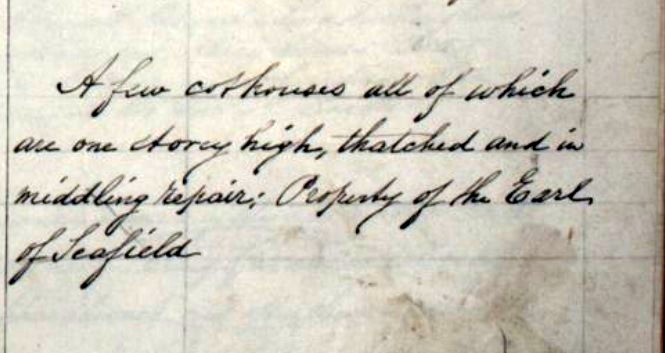
Ryduack and Straanruie were both the property of the Earl of Seafield in 1841. I suspect the lands and those surrounding are still held by the current Earl of Seafield, the 13th of his name, in Game of Thrones parlance, who still today owns vast swaths of land in the Strathspey area. Both place names are old Scots Gaelic. The original spellings left transcriptions through the years open to the imagination, when the skills of census takers and ordinance map scribes did not include accuracy and spelling.

Straanruie on ordinance map

Tomgown (or Tomghobhain in Gaelic) in the district of Tulloch, birthplace of Isabella, can also be found on the larger map.

My 3rd great grandmother, Margaret Davidson Smith, was a widow by 1841. I don't know when Donald Smith died, but it is safe to say that it was before the census was done. Here's a post about their family.

Marjory McDonald Ross, my other 3rd great grandmother, was also a widow. Her husband, Duncan, died in 1824. I wrote about their family here.

So, Alexander married the girl next door, only next door in this case was about five miles apart. Did the families visit by boat or by foot through the forest?

The ordinance survey name books collected between 1868 and 1876 and now held by ScotlandsPlaces describe both Ryuack and Straanruie.

Ryduack description, ScotlandsPlaces OS1/16/1/68


 Straanruie description, ScotlandsPlaces OS1/17/1/73

The third word in the description of Straanruie, cothouses, means a home for cottars, who usually had small pieces of land which they worked while also doing work for their land-holder, who was likely the local tenant farmer.

You're wondering when my 2nd great grandparents Alexander and Isabella got married, aren't you? So am I. So far, I haven't been able to find a marriage record. Their first child for whom there is a baptismal record was born in 1846.

Special thanks to three other family researchers who are wealths of information about all things Scotland, genealogy related.

The never ending story continues....


© Margaret Dougherty 2016-2019 All rights reserved


Wednesday, 14 August 2019

Roderick Mathieson (1868-1902)

Updated 26 Aug 2019

When I wrote this 2018 blog post about my 2nd great uncle John Mathieson and his family in Kinloss, Moray, Scotland, I had lost track of his son, my first cousin 2x removed, Roderick Mathieson, whom I speculated must have been a very strong man, as he was an iron forger.

1893 Toronto city directory
Recently, I discovered what happened to him. Roderick came to Canada, and while I haven't found exactly when, he first lived in Toronto, and by 1893, worked as a drop forger at Massey-Harris, which had massive facilities employing hundreds at that time in the west end of downtown.

He may have been in Canada before the 1891 census, as I've found an 1889 Toronto city directory entry, but he was not included in the 1891 Canada census.

source: City of Toronto Archives


On 7 Jun 1893, in a Presbyterian
ceremony, Roderick married Annie Mary McEachern of Eldon Township, in what was then Victoria County, Ontario. Eldon was settled by Scots, mainly from Argyll, in the late 1820s. Today, Victoria is part of the City of Kawartha Lakes. Annie's parents had emigrated from Scotland in 1861.

I don't know how they met--Annie was still in Eldon in 1891 when the census was done. She and Roderick don't appear to have had any children. Neither appear on the 1901 Canada census in Toronto or Eldon.

But, Roderick was at his father's in Kinloss when the 1901 census was conducted in Scotland, England and Wales, and was included in that census there. But by 2 May 1902, he was back in Canada, where he died from consumption. Did he go back to Scotland for a final visit with his family?

Roderick's death registration notes that he had consumption for up to four years. Perhaps as his health worsened, he was no longer able to work. As I said earlier, he must have been a very strong man to have been an iron forger. But he was no longer strong, and so he and Annie moved to Eldon, where she had a very large family for support. Did Annie go to Eldon when Roderick returned to Scotland for a final visit? Roderick's death was reported by one of Annie's brothers. I haven't found any burial information for Roderick. He was just 34 years old when he died. He and Annie were childless.

In all of the records I've found for Roderick in Canada, the spelling Matheson, with no "i", is used.

And what became of Roderick's widow, Annie? There was no trace of Annie after his death.....well, until, a few days after first writing this, I found that she remarried in 1912, in Victoria to William Clark Thompson, aged 50. And after that, there is no trace of either.

The never ending story continues....


© Margaret Dougherty 2016-2019 All rights reserved

About the Family of Robert Young and Isabella Knox

I wrote about my great grandfather, Robert Alexander Young , here . Now it's time to write about the family he and my great grandmother...